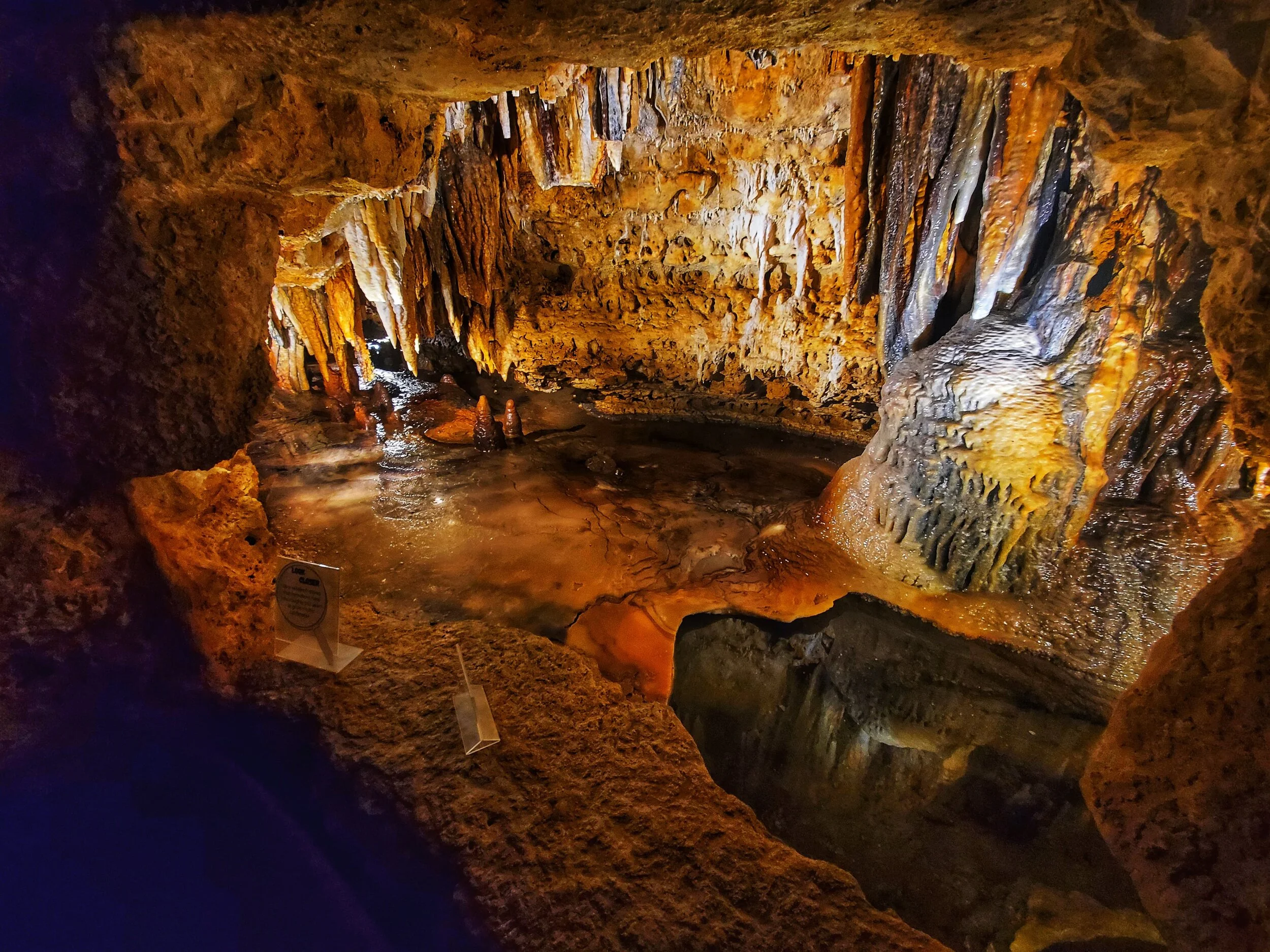
Beneath the rolling hills of Blue Mounds, Wisconsin, about 25 miles west of Madison, a cave system of extraordinary beauty lies hidden underground. Cave of the Mounds was discovered accidentally in 1939 when workers quarrying limestone inadvertently blasted into the cave chamber, revealing a world of stalactites, stalagmites, columns, and delicate cave formations that had been growing in darkness for hundreds of thousands of years. Today the cave is a National Natural Landmark and one of Wisconsin’s most popular tourist attractions, offering guided tours that take visitors through a sequence of beautifully decorated chambers that never fail to impress.
How the Cave Formed
Cave of the Mounds is a solution cave, formed when slightly acidic groundwater slowly dissolved the limestone bedrock over millions of years. The cave sits in the Ordovician-age Prairie du Chien dolomite formation, rock that is roughly 425 to 450 million years old. The cave passages and chambers formed first as empty voids. Then, over hundreds of thousands of years, water seeping through the overlying rock deposited calcium carbonate in an extraordinary variety of formations, building up the stalactites, stalagmites, flowstone, and other speleothems that visitors see today.
The cave’s condition is exceptionally well-preserved, largely because the discovery came relatively late and management began immediately with conservation as a priority. Unlike many historically significant caves that were damaged before protective practices were established, Cave of the Mounds has retained the delicate features that make it one of the finest examples of a decorated cave in the upper Midwest.
The Tour Experience
Guided tours of Cave of the Mounds run throughout the day and take approximately 45 minutes to complete. The paved, well-lit trail through the cave is accessible and comfortable, with even temperatures of around 50 degrees Fahrenheit year-round making it a pleasantly cool summer destination. Tour guides are knowledgeable and engaging, explaining the geology of the formations, the history of the cave’s discovery, and the ongoing process of cave formation that continues today.
The tour passes through a sequence of chambers, each with its own character and highlight formations. The Cathedral Room, one of the largest chambers, features dramatic formations and good acoustics that occasionally host musical performances. The Abyss is a deep shaft in the cave floor that provides a dramatic reminder of the cave’s vertical extent. Throughout the tour, the variety of formation types is impressive: slender soda straw stalactites, massive columns where stalactites and stalagmites have joined, delicate helictites growing in seemingly impossible directions, cave pearls formed in shallow pools, and broad flowstone sheets coating entire walls.
Photography is permitted throughout the cave, and the combination of the subtle cave lighting with the intricate formations provides excellent photographic opportunities. Wide-angle lenses are particularly useful in the larger chambers.
Gem Mining and Above-Ground Activities
The Cave of the Mounds property includes a well-developed surface attraction area beyond the cave itself. Gem mining, a sluice-based activity where visitors sort through bags of mineral-rich sand to find gems and minerals, is extremely popular with children and provides a hands-on connection to the geological themes of the cave tour. The gems found are real, including amethyst, rose quartz, garnet, and many other mineral specimens, and participants keep their discoveries.
A rock and mineral shop on the property carries an excellent selection of specimens from around the world, along with crystals, fossils, and geological curiosities. The shop is genuinely well-stocked and is worth browsing even for visitors with only a passing interest in geology. Picnic areas on the grounds provide a pleasant spot for lunch before or after the cave tour.
Blue Mounds State Park
Just a short drive from Cave of the Mounds, Blue Mounds State Park occupies the summits of the distinctive quartzite mounds that give the area its name. These ancient rock formations are among the highest points in southern Wisconsin and provide excellent views over the surrounding landscape. The park has hiking trails, a swimming pool, and camping, making it a good complement to a cave tour visit. The combination of the cave and the state park can easily fill a full day of exploration in the Blue Mounds area.
Getting There
Cave of the Mounds is located at 2975 Cave of the Mounds Road in Blue Mounds, Wisconsin, about 25 miles west of Madison off U.S. Highway 18/151. It’s easily done as a half-day trip from Madison or as a stop along the way between Madison and the Mississippi River valley. The cave is open year-round, with tours running continuously during business hours. Hours vary by season; summer hours are the most extensive. Admission is charged, with discounts for children and seniors.
Cave of the Mounds delivers a genuinely excellent cave experience that rewards visitors of all ages. The formations are beautiful, the interpretation is engaging, and the gem mining activity gives families a fun follow-up to the underground tour. If you’re in southern Wisconsin and haven’t visited, it’s one of those attractions that goes onto the repeat visit list after the first trip. A hidden world of stone and crystal, waiting just below the surface of a Wisconsin farm field, ready to astonish anyone who descends into it.