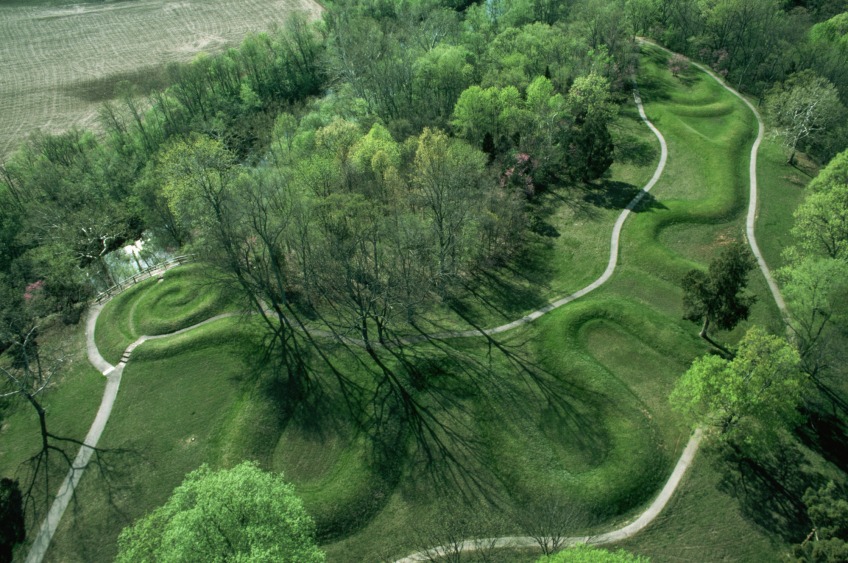
Just north of Delaware, Ohio, off a quiet county road that most people drive past without a second glance, a pair of ancient earthen mounds rise from a grassy field beside the Olentangy River. The Olentangy Indian Mounds are among the best-preserved and most accessible examples of Hopewell culture earthworks in the state, and unlike the more famous Serpent Mound to the south, these two mounds have been excavated and opened so that visitors can walk down inside them and stand in the burial chambers themselves.
That is not a common thing. Most prehistoric burial mounds in Ohio and the Midwest are closed, fenced off, or visible only from the outside. The chance to step down into an intact earthwork and look at the construction methods, the chamber walls, and the scale of the interior from the inside is rare enough that it justifies the drive on its own.
Who Built These Mounds and Why
The mounds were constructed by the Hopewell culture, a network of related Indigenous peoples who flourished across the eastern half of North America from roughly 100 BC to 500 AD. The Hopewell were not a single tribe or nation but a widespread cultural tradition defined by their elaborate burial practices, long-distance trade networks, and large-scale earthwork construction. They traded obsidian from the Rockies, copper from Lake Superior, mica from the Appalachians, and shark teeth from the Gulf Coast, assembling grave goods from across the continent for their most prominent members.
The two mounds at Olentangy were built as burial sites for individuals of apparent high status within the community. The larger mound is roughly 25 feet tall and about 100 feet in diameter at the base. Inside, archaeologists found multiple burial chambers containing human remains, ceramic vessels, mica cutouts, copper ornaments, and other ceremonial objects. The excavations were conducted in the 1890s, and the site was subsequently developed for public access.
What the Visit Is Like
The experience is genuinely intimate in a way that larger, more heavily managed sites rarely are. You walk up a short path to the first mound, descend a few stairs into the entrance, and find yourself inside a domed earthen chamber. The ceiling curves overhead, the walls are earthen and original, and the interpretive placards explain what was found during excavation and what it tells us about Hopewell burial customs. You come back out, walk a short distance, and repeat the experience in the second mound, which is slightly smaller and has a slightly different interior configuration.
The grounds around the mounds include a small museum building at the entrance with artifacts and contextual exhibits about Hopewell culture, the archaeological history of the site, and the broader network of earthworks across Ohio. The museum is modest in scale but substantive in content, and the staff are genuinely knowledgeable about the site and willing to talk through questions.
There is also a reconstructed Wyandot village on the property, representing a much later Indigenous cultural tradition, which adds a second layer of history to the visit. The Wyandot Nation lived in central Ohio for centuries after the Hopewell period ended, and their presence in this part of the state is its own important story.
Why It Stays Under the Radar
The Olentangy Indian Mounds sit about 25 miles north of Columbus, which is close enough for a half-day trip but far enough off the usual metro attractions that most central Ohio residents have never visited. The site is privately operated and charges a modest admission fee, which probably keeps it out of the reflexive list of free things to do in the area. And it lacks the visual drama of Serpent Mound, which benefits from aerial perspective and a clear effigy shape that photographs beautifully.
What the Olentangy mounds offer instead is access. You can touch the earthworks. You can stand inside them. You can get close to the construction in a way that most preserved prehistoric sites simply do not allow. For anyone with genuine interest in the ancient history of the Midwest, that access matters enormously.
Planning Your Visit
The Olentangy Indian Mounds are located at 1779 Ohio Highway 23 North in Delaware, Ohio. The site is open seasonally from spring through fall, with daily hours during the summer season and reduced hours in the shoulder months. Admission is charged for adults and children, with discounts for seniors and groups. The grounds are mostly flat and accessible on foot with no significant climbing required beyond the mound steps themselves.
Delaware, Ohio is a pleasant small city with a good downtown, and the mounds pair well with a stop in town or a drive along the Olentangy River corridor. If you are making a day of it from Columbus, the combination of the mounds, lunch in Delaware, and a drive through the Olentangy valley back south is a genuinely satisfying way to spend a few hours outside the normal Columbus orbit.
Ohio has more earthworks than any other state in the nation, and most of them go quietly unvisited by the people who live nearest to them. The Olentangy Indian Mounds are among the most accessible and most rewarding of the lot.