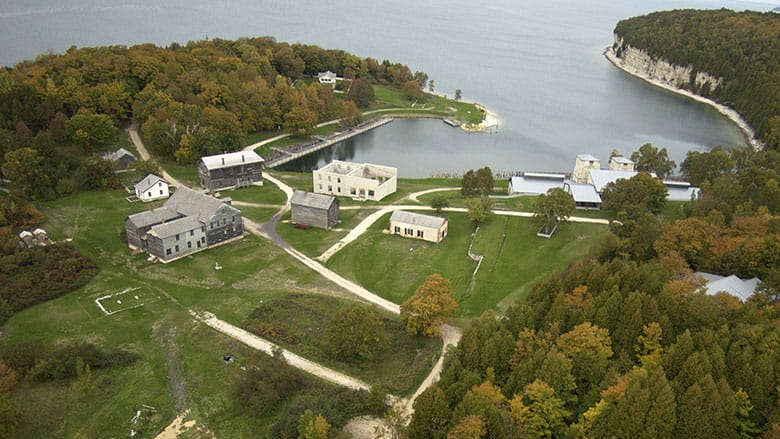
Tucked into a sheltered harbor on the Garden Peninsula of Michigan’s Upper Peninsula, Fayette Historic Townsite is one of the most remarkably preserved industrial ghost towns in the Great Lakes region. The limestone cliffs, the glassy bay, and the rows of intact stone buildings make it feel less like a state park and more like a film set for a 19th-century drama that never quite wrapped production.
Fayette was built in 1867 by the Jackson Iron Company, which chose this remote spot on the northern shore of Lake Michigan’s Big Bay de Noc specifically because it had everything a pig iron operation needed: towering hardwood forests to fuel the furnaces, a deep natural harbor for shipping, and a thick limestone bluff that could serve as raw material for the smelting process itself. Within a few years, the company had built a complete company town from scratch, including two massive stone blast furnaces, a superintendent’s house, worker housing, a hotel, a doctor’s office, a company store, and a town hall.
What Made Fayette Different
Unlike most industrial sites of the era, which were utilitarian and ramshackle by design, Fayette was planned with surprising care. The superintendent’s house was elegant by frontier standards, the hotel served meals to traveling businessmen, and the community had a genuine social life with dances, church services, and seasonal celebrations. At its peak in the 1870s and 1880s, around 500 people lived here year-round, working the furnaces, cutting timber, and keeping the harbor running.
The iron production process at Fayette was impressive by any measure. The furnaces ran continuously, processing ore shipped in from mines on the Marquette Iron Range and consuming enormous quantities of local hardwood charcoal. At peak output, the site was producing tens of thousands of tons of pig iron annually, all of it loaded onto schooners and steamers bound for foundries in lower Michigan, Ohio, and beyond.
Why It Shut Down So Suddenly
The end came quickly. By the early 1890s, Fayette’s charcoal-fueled furnaces simply could not compete with the newer, larger coke-fired operations that had come to dominate the steel industry. The surrounding forests had been heavily cut, making charcoal production increasingly expensive. In 1891, after just 24 years of operation, the Jackson Iron Company shuttered the site entirely. The workers packed up and left, and Fayette went quiet almost overnight.
What makes the site remarkable today is what happened next: almost nothing. Fayette changed hands a few times over the following decades, was used briefly as a summer resort, and then sat largely undisturbed until the state of Michigan acquired it in 1959. Because no one ever demolished the buildings or repurposed the land, the stone structures survived intact. The Michigan Department of Natural Resources has since stabilized and partially restored the site, and today visitors can walk through more than 20 surviving structures in various states of preservation.
What You’ll See When You Visit
The self-guided walking tour covers the full townsite, which is compact enough to explore in two to three hours. The two blast furnaces are the centerpiece, their towering stone forms rising above the harbor edge, and the interpretive displays inside explain exactly how the smelting process worked. The furnace complex alone is worth the drive.
Beyond the furnaces, the tour takes you through the superintendent’s house, the company store, the opera house, the machine shop, and rows of worker housing. Some buildings have been fully restored with period furnishings; others are stabilized ruins that let you see the original construction in honest detail. The combination of the stone architecture and the harbor backdrop is genuinely striking.
The harbor itself is gorgeous. Kayakers and canoeists paddle into the bay regularly, and the limestone bluffs on the opposite shore give the whole scene a scale that photographs struggle to capture. There is a small visitor center at the park entrance with exhibits on the history of iron production in the region, and a campground nearby if you want to stay for sunset when the light on the old stone walls turns a deep amber.
Getting There
Fayette Historic Townsite is part of Fayette Historic State Park, located about 17 miles south of Garden on M-183. It is a genuine destination drive, sitting roughly 70 miles south of Escanaba on a peninsula that most travelers pass right by on their way to the Pictured Rocks or the Porcupine Mountains. That remoteness is part of what has kept it off the mainstream radar, and part of what makes the trip feel worthwhile.
Michigan Recreation Passport is required for entry and is available at the gate. The walking trails are accessible on foot; the harbor area has a boat launch and docking facilities for those arriving by water. Summer is the best time to visit when the interpretive programs are running, though the site is open for self-guided tours from spring through fall.
If you are driving across the Upper Peninsula and looking for a reason to leave the main corridor, Fayette is one of the best detours on the map. It is the kind of place that holds your attention in ways that conventional tourist attractions rarely do, a real town that real people built and left behind, still standing exactly where they left it.