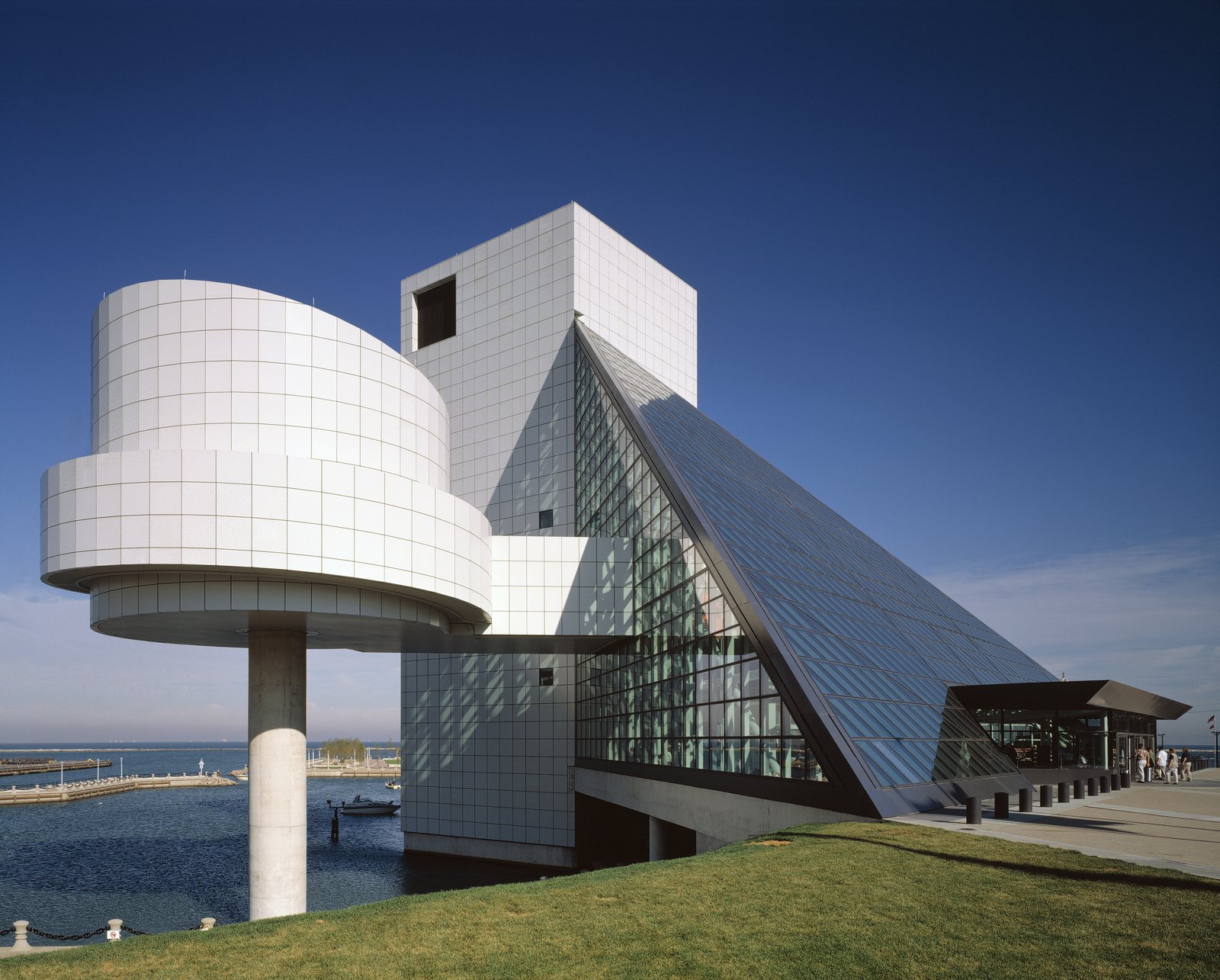
On the shore of Lake Erie in downtown Cleveland, housed in a striking glass pyramid designed by architect I.M. Pei, the Rock and Roll Hall of Fame and Museum is one of the most visited museums in Ohio and one of the most distinctive cultural attractions in the entire Midwest. It is at once a celebration of a uniquely American art form, an archive of popular music history, and an endlessly entertaining destination for anyone who has ever loved a song. Whether you consider yourself a music buff or a casual listener, the Rock Hall delivers an experience that is hard not to enjoy.
The Building and Its Setting
The Rock Hall’s architecture is as much a statement as a container. I.M. Pei’s design, completed in 1995, features a dramatic 162-foot tower of glass rising from the lakefront and a series of geometric forms that give the building a distinctive silhouette visible from across downtown Cleveland. The glass construction floods the interior with natural light and creates a constantly changing interplay of reflections. The building sits at the edge of the North Coast Harbor, with Lake Erie and a public plaza immediately outside. The lakefront setting is part of what makes visiting the museum special: you arrive with the lake on one side and the Cleveland skyline on the other, and the whole approach feels like arriving at something significant.
The Inductees and Their Stories
The core experience of the Rock and Roll Hall of Fame is learning about the artists who have been inducted and the impact they’ve had on music and culture. Induction requires a 25-year wait from an artist’s first commercial release, and the inductees represent an astonishing breadth of talent and genre, from Elvis Presley and Chuck Berry to the Beatles, Led Zeppelin, Bruce Springsteen, Aretha Franklin, Madonna, and beyond. The class of inductees grows each year, and the annual induction ceremony, typically held in the spring, is a major event in the music world.
Each inductee is represented in the museum through exhibits that include photographs, memorabilia, video, and audio. The displays are well-designed and genuinely engaging, telling the stories of artists’ careers in ways that illuminate not just their music but their broader cultural significance. The connections between artists, the way one generation of musicians influenced the next, and the way rock and roll grew from blues, gospel, country, and R&B roots, are all explored thoughtfully throughout the museum.
Artifacts and Memorabilia
For music fans, the artifact collection at the Rock Hall is extraordinary. The museum holds more than 100,000 items in its archive, and a rotating selection is always on display. Jimi Hendrix’s psychedelically painted guitars, John Lennon’s hand-written lyrics to Beatles songs, Jim Morrison’s Cub Scout uniform, Michael Jackson’s stage costumes, and Kurt Cobain’s cardigan from the MTV Unplugged performance are just a handful of the items that regularly stop visitors in their tracks. These objects carry an almost talismanic power: they connect you directly to the moments and the music in a way that recordings alone cannot.
The Hall’s special exhibition spaces typically host rotating shows on specific artists, eras, or themes in music history. Past exhibitions have covered the history of hip-hop, the influence of women in rock, the Grateful Dead’s visual culture, and tributes to recently inducted artists. These special exhibits give regular visitors a reason to return and ensure that the museum’s offerings are always evolving.
The Theater Experiences
The museum contains multiple theater spaces that screen music videos, performance footage, and documentary films throughout the day. The main theater shows a rotating program of music films and concert footage, while smaller screening rooms focus on specific artists or themes. Sitting in a darkened theater watching footage of a legendary live performance is one of those Rock Hall experiences that goes beyond reading exhibit labels. The performance footage collection, which includes rare concert recordings from across the full history of rock music, is genuinely priceless.
Cleveland’s Connection to Rock and Roll
Cleveland has a legitimate claim to the title Rock and Roll Capital of the World, and not just because it hosts the Hall of Fame. Cleveland disc jockey Alan Freed is widely credited with coining the term rock and roll and popularizing the music among white audiences in the early 1950s through his radio programs. Cleveland was one of the first cities where rock and roll was embraced, and the city’s musical legacy runs deep. The museum explores this local history alongside the broader national story of the music, giving Cleveland visitors a particular reason to feel proud of the connection.
Practical Tips for Your Visit
The Rock and Roll Hall of Fame is located at 1100 East 9th Street on the Cleveland lakefront, a short walk from FirstEnergy Stadium and the Great Lakes Science Center. It’s open daily, with extended hours on certain weekends and during special events. Admission is charged, with discounts available for seniors, students, and children. The museum can easily consume a full day for serious music fans; a more selective visit takes about three to four hours. An audio guide is available and adds depth to many of the exhibits.
Parking is available in garages near the museum and in the North Coast Harbor lot adjacent to the building. The museum is also accessible by public transit from downtown Cleveland. A combined visit with the Great Lakes Science Center next door or a walk along the lakefront to Voinovich Bicentennial Park makes for a satisfying full day on the Cleveland waterfront.
The Rock and Roll Hall of Fame is one of those institutions that earns its reputation. The building is beautiful, the collection is outstanding, and the whole experience manages to convey genuine reverence for music without ever becoming stiff or academic. Come ready to feel something, because this museum has a way of delivering unexpected emotional moments: the sight of a beloved guitar, the sound of a great song filling a darkened theater, the realization of how much music has meant to American life. It’s worth every minute.