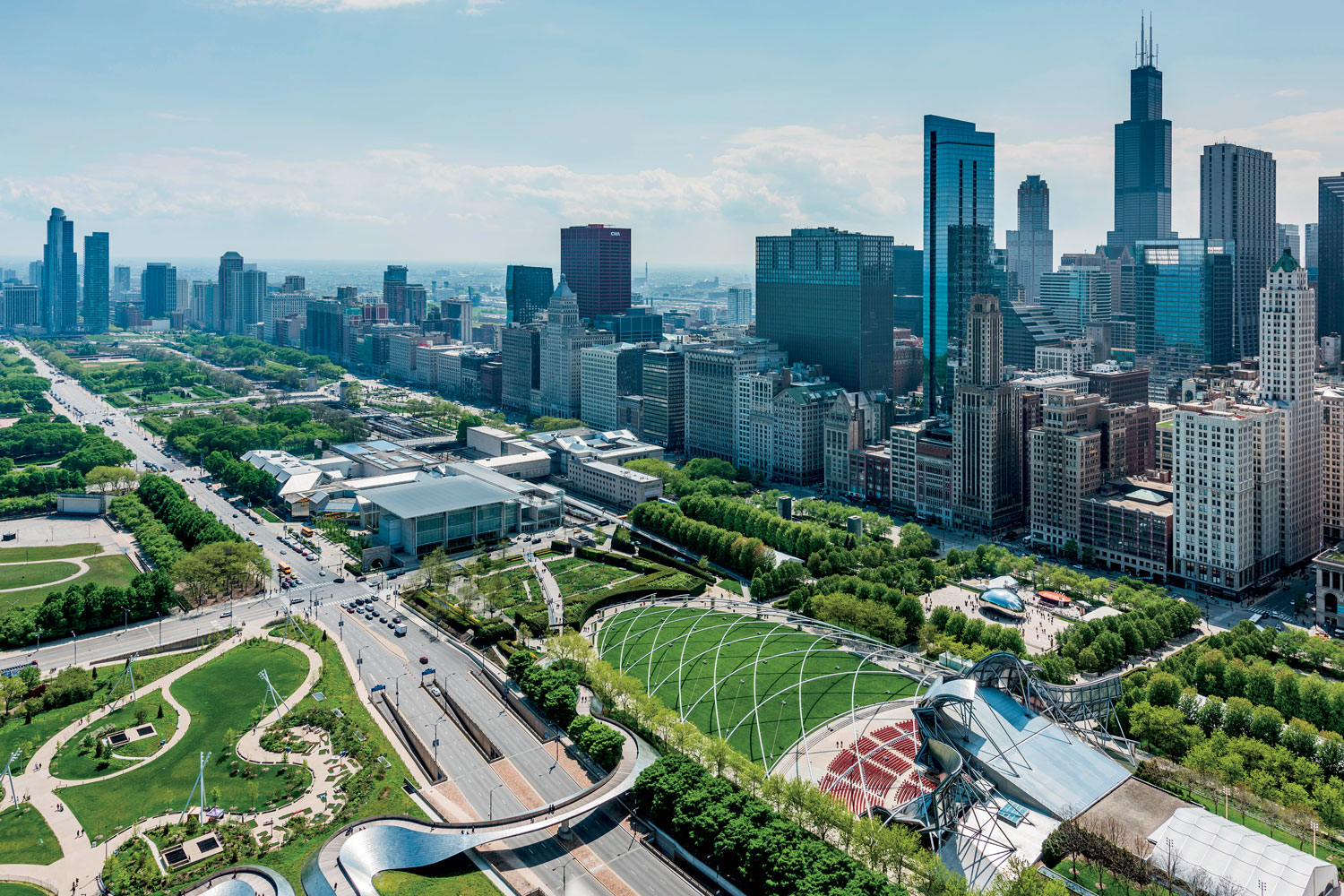
In the heart of downtown Chicago, where the glittering skyline meets the shimmering surface of Lake Michigan, Millennium Park stands as one of the most celebrated urban green spaces in the country. Since its opening in 2004, this 24-acre park has become the cultural and recreational centerpiece of the city, drawing millions of visitors each year with its world-class public art, beautifully landscaped gardens, and a packed calendar of free events. A visit to Chicago without spending time in Millennium Park simply isn’t complete.
The Crown Jewel: Cloud Gate
Nothing symbolizes Millennium Park more immediately than Cloud Gate, the gleaming, bean-shaped sculpture by British-Indian artist Anish Kapoor that Chicagoans have affectionately nicknamed The Bean. Made from 168 polished stainless steel plates with no visible seams, Cloud Gate reflects the skyline, the clouds, and the faces of every visitor who approaches it in a delightfully distorted, funhouse-mirror fashion. Walking beneath its arched underside, known as the omphalos or navel, reveals a swirling vortex of reflections that never gets old. The Bean is at its most magical in the early morning before crowds arrive, and again at night when the surrounding skyscrapers light up and the sculpture becomes a glowing orb of reflected gold and silver.
Crown Fountain
Just a short walk from Cloud Gate, Crown Fountain is another must-see installation that blurs the line between art and interactive play. Czech artist Jaume Plensa designed two 50-foot glass block towers that face each other across a shallow reflecting pool. Video images of Chicago residents’ faces are projected on each tower, and during warmer months, water spouts from the towers’ openings in a way that mimics the traditional function of a gargoyle fountain. Children splash through the pool with abandon, and even adults can’t resist stepping in on a hot summer day. The fountain is turned off in winter, but the towers continue to display their rotating portraits year-round.
The Jay Pritzker Pavilion
The stunning Jay Pritzker Pavilion, designed by legendary architect Frank Gehry, is an architectural marvel in its own right and serves as the park’s main performance venue. Its distinctive stainless steel headdress frames the stage in undulating ribbons of metal, and a trellis of steel pipes extending over the Great Lawn carries a sophisticated sound system that delivers concert-quality audio to the entire outdoor audience. The pavilion hosts the Grant Park Music Festival, one of the nation’s only free outdoor classical music series, throughout the summer, along with jazz concerts, film screenings, and a popular summer music festival called Chicago SummerDance. Bringing a blanket, a picnic dinner, and settling in on the Great Lawn for a free concert on a summer evening is one of Chicago’s finest traditions.
Lurie Garden
Tucked behind the Pritzker Pavilion, Lurie Garden is a five-acre botanical sanctuary that feels like a secret world within the park’s bustle. Designed by landscape architect Gustafson Guthrie Nichol, the garden is divided into two contrasting areas: the Dark Plate, featuring shade-loving plants with deep purples and blues, and the Light Plate, a sun-drenched expanse of grasses and perennial flowers. The garden is at its peak in late spring and summer, but it’s designed for four-season interest, with ornamental grasses catching the light beautifully in autumn and the skeletal forms of seed heads persisting through winter. Free guided tours are offered on weekends throughout the warmer months.
BP Bridge and Beyond
Another Frank Gehry creation, the BP Bridge is a sinuous, 935-foot pedestrian walkway that winds from Millennium Park across Columbus Drive to Daley Bicentennial Plaza. The bridge’s stainless steel cladding and gently curving form make it as much a sculptural object as a piece of infrastructure. Walking across it offers terrific views of both the park and the city. Once in Daley Bicentennial Plaza, you’re just steps from the lakefront trail, which extends for miles along the Lake Michigan shoreline in both directions.
Ice Skating in Winter
When temperatures drop, the McCormick Tribune Ice Rink in the heart of the park opens for free public skating. Skate rental is available on-site, and the rink is surrounded on three sides by the dramatic backdrop of the park’s architecture and the city skyline. Skating here, with Cloud Gate gleaming nearby and the tall buildings rising overhead, is one of the most memorable cold-weather activities Chicago offers. The rink typically operates from late November through early March.
Getting to Millennium Park
Millennium Park couldn’t be more centrally located. It sits along Michigan Avenue between Randolph Street and Monroe Street, directly across from the Art Institute of Chicago, and just a few blocks from some of the city’s best shopping along the Magnificent Mile. Public transit is the recommended way to arrive: the Brown, Green, Orange, Pink, and Purple CTA elevated train lines all stop at Randolph/Wabash, just one block away. The Red Line’s Lake station on State Street is also close by. Parking is available in the Millennium Park Garage beneath the park, accessible from Columbus Drive, though it fills quickly on busy days.
Practical Tips for Your Visit
Admission to Millennium Park is always free, making it an ideal destination regardless of budget. The park is open daily from 6 a.m. to 11 p.m. Most of the major installations are accessible year-round, though some amenities like the fountain and ice rink are seasonal. The park gets very crowded on summer weekends, so visiting on a weekday morning gives you the best chance to enjoy Cloud Gate without jostling through large groups. Combining a visit to the park with stops at the nearby Art Institute of Chicago, the Chicago Riverwalk, and Navy Pier makes for a thoroughly satisfying day in the city.
Millennium Park is Chicago at its best: ambitious, beautiful, accessible, and alive with energy. Whether you’re a first-time visitor or a longtime Chicagoan, there’s always something new to discover here. Spend an afternoon wandering its grounds and you’ll leave with a genuine appreciation for what a city can accomplish when it invests in art, architecture, and open space for everyone.