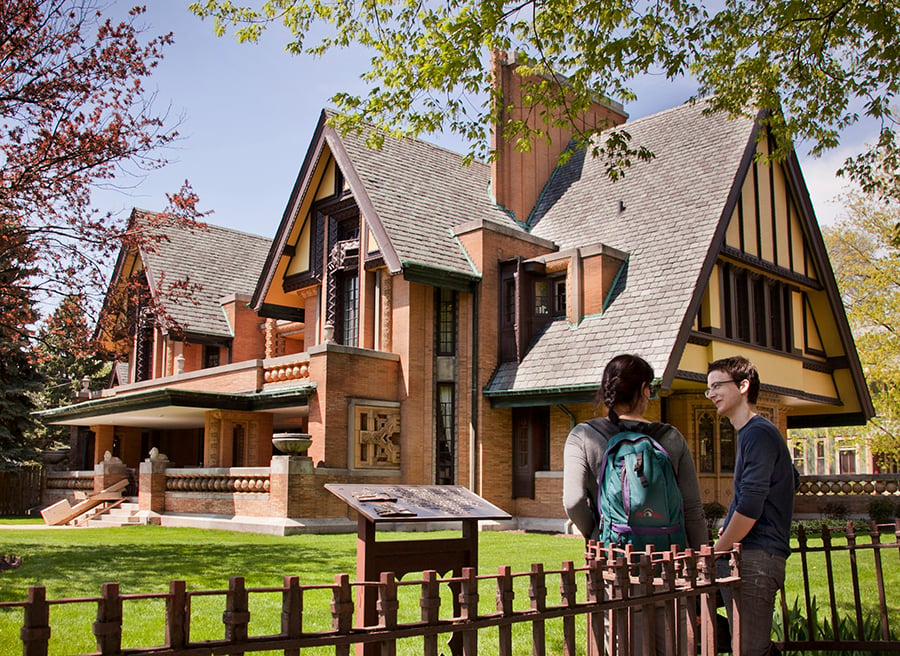
In the leafy, historic suburb of Oak Park just west of Chicago, on a quiet corner of Forest Avenue, stands the house where Frank Lloyd Wright lived and worked for the first 20 years of his professional career. The Frank Lloyd Wright Home and Studio is where the world’s most influential American architect developed the ideas that would eventually transform architecture worldwide, and it is preserved and interpreted today as one of the most important historic sites in the Midwest. For anyone interested in architecture, design, or American cultural history, a visit to Oak Park to see Wright’s home and the surrounding neighborhood of early Prairie Style buildings is an experience of exceptional richness.
The Home and Studio
Wright designed his home in 1889, when he was just 22 years old, and he continued to redesign and expand it throughout his time in Oak Park. The building that visitors see today is a fascinating hybrid that reflects different periods of Wright’s thinking, incorporating elements of the Shingle Style that was fashionable when he began to the fully formed Prairie Style ideas he had developed by the time he left the property in 1909. The playroom addition, designed in 1895, is a particularly remarkable space: an octagonal room with a barrel-vaulted ceiling, clerestory windows, and a large mural above the fireplace that Wright designed for his children.
The studio was added to the property in 1898 and is where Wright worked with his draftsmen on many of his most important early commissions, including Unity Temple and the early Prairie house designs that would make him famous. The studio’s reception room and drafting room are fascinating spaces, particularly the octagonal drafting room with its chain-hung balcony, where Wright’s assistants worked on the large drawings required for his increasingly ambitious projects.
Guided tours of the home and studio are the primary way to visit, with knowledgeable guides from the Frank Lloyd Wright Trust leading groups through the interiors and explaining the architectural significance of each space. The tours are excellent and manage to make the architecture accessible and engaging for visitors with no architectural background as well as for those who come with deep knowledge of Wright’s work.
The Prairie Avenue Historic District
Oak Park is home to the largest concentration of Frank Lloyd Wright-designed buildings in the world, with more than 25 buildings in the village designed or significantly contributed to by Wright during his Oak Park years. Many of these buildings line the streets within a short walk of the home and studio, and the Frank Lloyd Wright Trust offers walking tours of the neighborhood that take visitors past the most significant examples. Even without a guided tour, the self-guided walking tour map available at the home and studio allows visitors to explore the neighborhood on their own and observe the evolution of Wright’s residential design over 20 years.
The early houses reflect Wright’s break from the Victorian styles that dominated American residential architecture at the turn of the century. His Prairie houses have low horizontal lines that emphasize the relationship between house and ground, broad overhanging roofs that shelter the windows from direct sunlight, open floor plans that flow freely between spaces, and an integration of nature into the design through carefully considered views, gardens, and the use of natural materials throughout.
Unity Temple
A short walk from the home and studio, Unity Temple is widely considered one of the most important buildings in the history of American architecture and is a UNESCO World Heritage Site as part of the Frank Lloyd Wright Architecture collection. Designed in 1905 and completed in 1908, Unity Temple was Wright’s first masterwork in reinforced concrete and represents a revolutionary approach to public building design. The building’s exterior is austere and geometrically severe, giving no hint of the extraordinary interior that awaits. Inside, the main worship space is a rich, complex composition of amber light, geometric ornament, and carefully modulated space that achieves a profound sense of serenity and presence.
The Unity Temple has been beautifully restored and offers regular tours and self-guided visits. Experiencing the interior firsthand, with the natural light filtering through the art glass windows and the whole composition revealing itself gradually as you move through the space, is one of the finest architectural experiences in the Midwest.
Ernest Hemingway in Oak Park
Frank Lloyd Wright was not the only great American modernist to grow up in Oak Park. Ernest Hemingway was born here in 1899 and spent his formative years in the village. The Ernest Hemingway Birthplace and Museum are both open to visitors and provide context for the writer’s early life in this prosperous, culturally conservative suburb that he later described acidly but that clearly shaped his sensibility. The combination of Wright and Hemingway makes Oak Park a uniquely rewarding destination for anyone interested in American cultural history.
Getting There
Oak Park is located about 10 miles west of downtown Chicago and is easily accessible by the Green Line and Blue Line CTA elevated train, making it one of the best day trips from Chicago by public transit. The Frank Lloyd Wright Home and Studio is located at 951 Chicago Avenue in Oak Park. Tours are offered daily, with advance reservations recommended for weekend visits. The Frank Lloyd Wright Trust also runs tours of Unity Temple and the neighborhood walking tours. A combined ticket for the home and studio plus the neighborhood walking tour provides the most comprehensive experience.
The Frank Lloyd Wright Home and Studio is a pilgrimage site for architecture lovers and a genuinely accessible and fascinating experience for anyone with an interest in how ideas change the world. Wright started here, in this house on a quiet Oak Park street, and what he thought and built here eventually changed the appearance of cities across the globe. Seeing where it began is worth the short trip from Chicago.