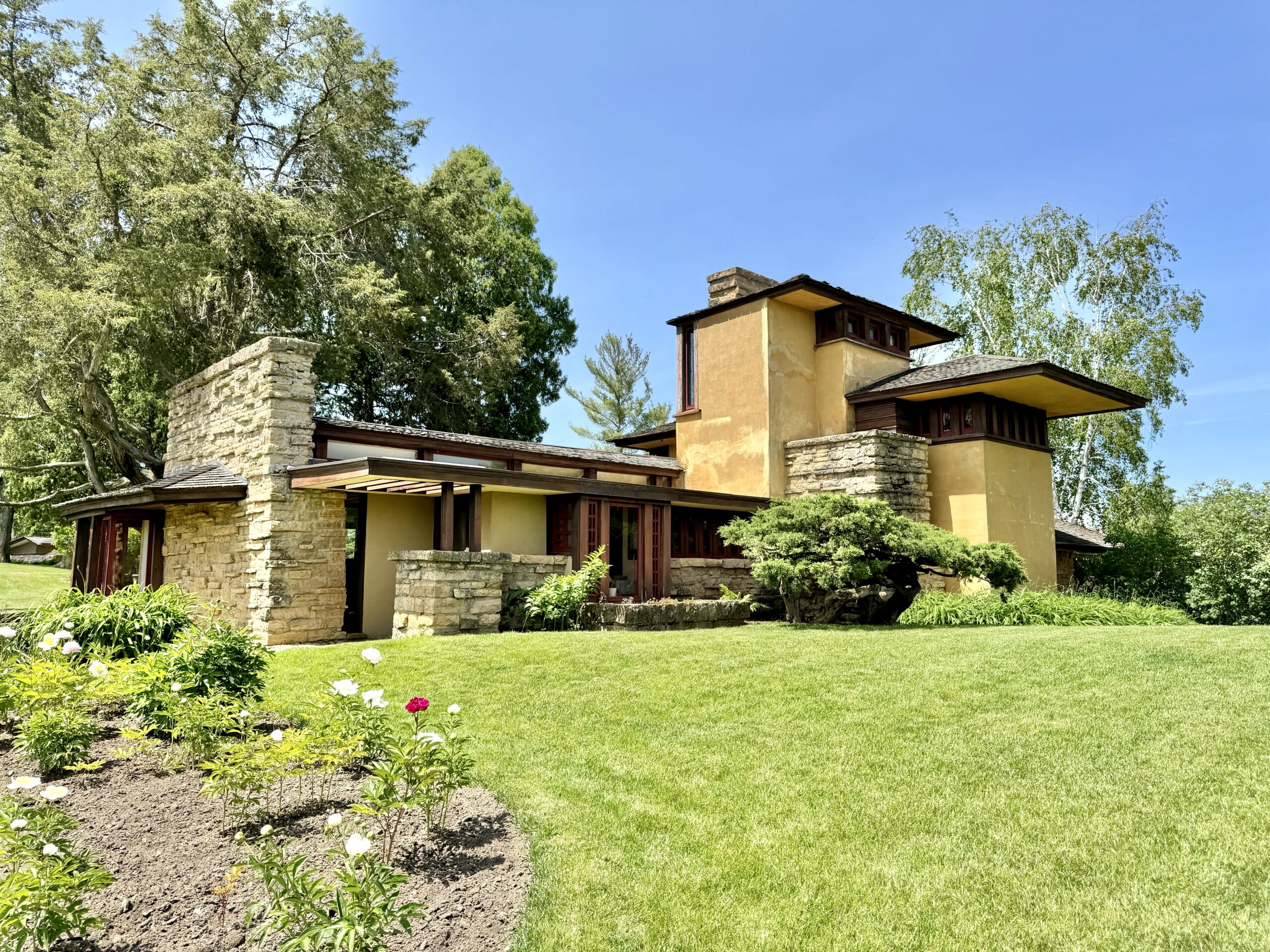
In the gentle valleys of the Wisconsin River near the village of Spring Green, one of the most important complexes of buildings in American architectural history occupies a hillside overlooking the agricultural landscape that shaped the imagination of its creator. Taliesin was the home, studio, school, and lifelong laboratory of Frank Lloyd Wright, the most celebrated American architect of the 20th century. Built, rebuilt, and constantly revised across more than five decades, the Taliesin estate is where Wright developed the ideas that changed architecture worldwide, and visiting it today is one of the most intellectually and aesthetically rewarding experiences Wisconsin has to offer.
Frank Lloyd Wright and Taliesin
Frank Lloyd Wright was born in Richland Center, Wisconsin, in 1867 and spent formative summers in the Spring Green area working on his maternal family’s farm. The landscape of the Wisconsin River valley, with its gentle hills, native stone outcroppings, and views across fields and forest to the horizon, shaped his sense of what buildings should be in relation to the land. When Wright returned to Wisconsin in 1911 to build his own home, he chose a hilltop in this beloved landscape and named the house Taliesin, a Welsh word meaning shining brow, reflecting his Welsh heritage and the house’s position just below the hilltop rather than on it, in keeping with his belief that buildings should complement rather than dominate the landscape.
Wright lived at Taliesin for most of his adult life, working here from 1911 until his death in 1959 with interruptions for his time in Arizona at Taliesin West. The property grew over the decades to include a drafting studio where he worked with his apprentices, a working farm, several outbuildings, and the Hillside Home School building originally designed for his aunts. Two major fires destroyed portions of the original complex and were rebuilt by Wright, making the surviving structures the result of multiple rebuilding campaigns that reflect the evolution of his thinking over 50 years.
The Tours
Taliesin is operated today by the Frank Lloyd Wright Foundation as a historic site and is open for tours from May through October. Several tour options are available, ranging from a two-hour architectural walking tour of the main buildings to a four-hour estate tour that covers the full property including the gardens and outlying structures. The Hillside tour focuses on the large studio and theater complex that Wright designed for the Taliesin Fellowship, his residential school for architecture students. The intimate house tour, limited to small groups, provides a closer look at the living spaces of the main Taliesin house.
The tour guides at Taliesin are knowledgeable and passionate about Wright’s work and life, and they bring the buildings alive with stories about Wright’s personality, his working methods, his relationships with his apprentices, and the specific design ideas expressed in each space. The buildings themselves are endlessly interesting to anyone with an eye for space, light, and the relationship between interior and exterior that Wright mastered across his career.
The Architecture
Taliesin exemplifies Wright’s Prairie Style and Organic Architecture principles in a domestic and studio context. The buildings are built from local limestone and natural wood, rooted in the landscape’s own materials. The roofs are low and wide-overhanging, the windows are horizontal bands that frame the landscape as if it were a series of paintings, and the circulation through the buildings creates a constant sense of movement and discovery. No two rooms are alike. Ceilings vary in height to create compression and release. Views open and close as you move through the spaces, orchestrated to reveal specific landscape compositions at specific moments.
The Japanese tea house in the garden, the loggia with its incomparable views over the valley, and the drafting studio where Wright produced thousands of drawings over decades are among the specific spaces that most powerfully convey the character of Taliesin. Wright designed nearly every furnishing, light fixture, and decorative element in the house, creating a total artwork environment that is impressive even in its current preserved state.
The Surrounding Area
The Spring Green area has additional Wright-designed buildings that can be visited in conjunction with Taliesin. The Unity Chapel, a small country church that was the first building Wright contributed designs to as a teenager, is located nearby. The American Players Theatre, an outstanding outdoor classical theater company, performs on a hillside just a few miles from Taliesin each summer and makes a wonderful evening pairing with a day of architectural tourism. The village of Spring Green has good restaurants and some lodging options, though the Taliesin area itself is primarily rural.
Getting There
Taliesin is located on County Road C, about 3 miles south of the village of Spring Green, Wisconsin, and about 40 miles west of Madison via U.S. Highway 14. Tours depart from the Riverview Terrace Cafe, a Wright-designed visitor building on the bank of the Wisconsin River below the main Taliesin complex. Reservations are strongly recommended, especially for summer weekends. The Frank Lloyd Wright Visitor Center and the Riverview Terrace Cafe are good places to begin any visit, with exhibits on Wright’s life and work that provide useful context before the tour.
Taliesin is for anyone who has ever been moved by a beautiful building, anyone who has ever wondered what it means for architecture to be genuinely alive, or anyone who simply wants to understand why Frank Lloyd Wright matters. It is a place of profound beauty, extraordinary intellectual depth, and the particular kind of peace that comes from being in a building that belongs completely to its landscape. A visit here is an experience that rewards reflection long after you’ve returned home.