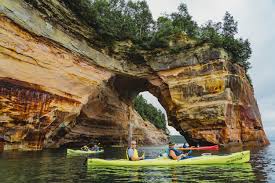
Along the southern shore of Lake Superior in Michigan’s Upper Peninsula, a stretch of sandstone cliffs rises from the cold, blue-green water in a riot of color and form unlike anything else in the Great Lakes region. Pictured Rocks National Lakeshore, the first national lakeshore established in the United States, protects 42 miles of this extraordinary shoreline and the forests and lakes that stretch inland from it. It is, without question, one of the most visually stunning destinations in the entire Midwest, and it more than justifies the long drive required to reach it.
The Cliffs That Define the Park
The park gets its name from the multicolored sandstone cliffs that form its most iconic section, stretching roughly 15 miles between Munising and Au Sable Point. These cliffs, formed from Cambrian-age sandstone deposited roughly 510 million years ago, have been sculpted by thousands of years of wave action and frost into a spectacular gallery of arches, caves, towers, and alcoves. Minerals leaching through the rock have stained the cliff faces in vivid streaks of orange, red, pink, blue, green, and white, creating the painted effect that gives the lakeshore its name.
The cliffs are best appreciated from the water. Kayak or boat tours departing from the town of Munising take visitors along the base of the cliffs at water level, revealing sea caves, arch formations, and waterfalls that cascade directly into the lake. Pictured Rocks Cruises, operating out of Munising, offers narrated boat tours that cover the full length of the cliff section in about three hours. This is perhaps the most popular activity in the park and provides views that are simply impossible to get any other way.
Hiking the Lakeshore Trail
The Lakeshore Trail runs the entire 42-mile length of the park from Munising to Grand Marais and is one of the premier backpacking routes in the Midwest. Most hikers complete it as a multi-day trip, camping at designated backcountry sites along the route. The trail combines cliff-top walking with forest hiking, beach stretches, and views of several dramatic waterfalls, making it one of the most varied long-distance hikes in the region. Day hikers can access many of the best sections of the trail from trailheads at various points along County Road H-58, which parallels the park.
Miners Beach and Miners Castle are among the most popular short hike destinations in the park. Miners Castle is a dramatic rock formation that juts into the lake near the western end of the cliff section, and the short trail to its overlook provides one of the park’s most photographed views. From the overlook, you can see the vivid blue of Lake Superior stretching to the horizon and, on clear days, look down into water so transparent that the rocky bottom is visible many feet below the surface.
Chapel Falls and the Inland Waterfalls
Pictured Rocks is home to several impressive waterfalls, most of which are accessible via day hikes from the park’s interior trailheads. Chapel Falls, one of the most beautiful, drops nearly 90 feet over a sandstone ledge into a gorge that winds down to the lakeshore. The 10-mile Chapel Loop trail combines Chapel Falls with a visit to Chapel Rock, an iconic sea stack with a lone tree growing from its flat summit, and Chapel Beach, a wild stretch of sand fronting the open lake. It’s one of the finest day hikes in the Upper Peninsula.
Munising Falls, located just outside the town of Munising near the park’s western entrance, is an easily accessible waterfall that flows behind an overhanging sandstone ledge, creating a natural alcove that visitors can walk behind. It’s a short, flat walk from the parking area and makes a great first stop when entering the park from the west.
The Twelvemile Beach and Grand Sable Dunes
The eastern portion of Pictured Rocks is anchored by Twelvemile Beach, a long, wild strand of sand backed by forest that is one of the most serene Lake Superior beaches accessible by car. The swimming is cold but invigorating, and the beach is rarely crowded. Nearby, the Grand Sable Dunes rise steeply above the lake in a dramatic landscape of wind-sculpted sand that feels surprisingly reminiscent of a desert. The dunes are perched on top of Grand Sable Banks, 300-foot glacial bluffs that drop sharply to the lake below. Walking along the dune crest offers breathtaking views in both directions.
At the park’s eastern end, the town of Grand Marais is a tiny, wonderfully remote community with a small harbor, a handful of restaurants and shops, and a deeply relaxed atmosphere. Grand Marais makes a good base for exploring the eastern sections of the park and has a small campground right in town.
When to Visit and How to Get There
Summer, from mid-June through early September, is the primary season at Pictured Rocks. The weather is mild, all park facilities are operating, and the boat tours are running. Fall brings spectacular foliage color, typically peaking in late September and early October, and the reduced crowds of shoulder season. The park is technically open year-round, and winter visitors can snowshoe or cross-country ski the lakeshore trail and witness the stunning ice formations that build up on the cliffs in cold years.
Munising is the main gateway community and is located about 45 miles east of Marquette, the Upper Peninsula’s largest city. From the Lower Peninsula, the drive from the Mackinac Bridge to Munising takes roughly two to two and a half hours. The remoteness is part of the appeal, but it does require planning. Lodging options in and around Munising range from basic motels to vacation rentals, and campgrounds within the park fill up quickly in July and August.
Pictured Rocks National Lakeshore is one of those destinations that genuinely exceeds expectations. The cliffs are more vivid, the lake is more impossibly blue, and the overall sense of wildness is more powerful than any photograph can convey. If you haven’t been, it belongs near the top of your Midwest travel list. Go, and go with enough time to do it justice.