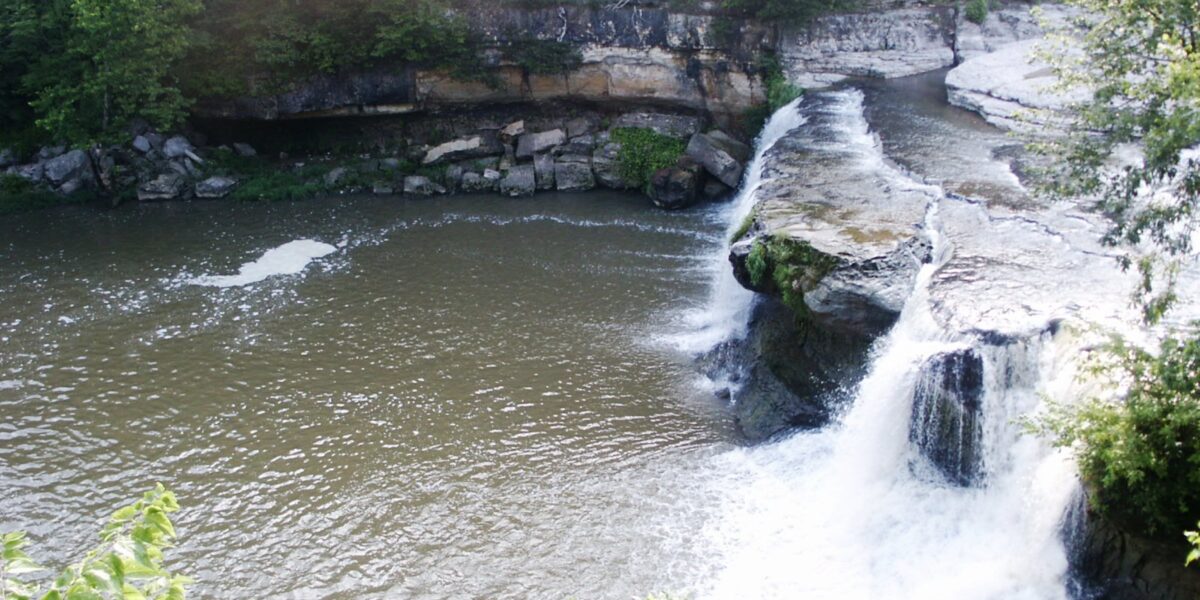
Cataract Falls State Recreation Area near Cloverdale, Indiana, in Owen County, is home to the largest waterfall by volume in the state, a fact that surprises most visitors who have spent years assuming Indiana has no waterfalls worth mentioning. The Upper Falls at Cataract drop 45 feet over a limestone ledge in a broad, powerful cascade that commands genuine respect, and the Lower Falls downstream add another dramatic plunge to a site that rewards a full morning of exploration. This is one of Indiana’s most beautiful natural areas, and its relative obscurity compared to the state’s more famous parks makes it all the more rewarding to visit.
The Falls
Mill Creek, which drains a large watershed in the Owen and Putnam County hill country, reaches the Cataract Falls site with enough volume and enough elevation change to create two distinct waterfalls within a short stretch. The Upper Falls, the larger and more dramatic of the two, span roughly 100 feet across and drop over a series of limestone ledges in a wide curtain of white water. During spring flood conditions, the falls can reach flows that rival many much more famous cascades in the eastern United States, and the roar they produce fills the surrounding valley impressively. Even in the drier late summer months, the falls maintain a respectable flow that justifies the visit.
The Lower Falls, accessible by a short trail downstream from the Upper Falls, are a narrower but arguably more elegant drop that plunges into a deep pool surrounded by vertical limestone walls. The pool below the Lower Falls is particularly photogenic in the warm light of early morning or late afternoon, when the sun catches the mist from the falls and the color of the limestone walls glows warm amber. In winter, both falls partially freeze into dramatic ice formations that attract dedicated photographers willing to navigate the trails in cold conditions.
History on the Creek
The name Cataract comes from the village of Cataract that grew up near the falls in the 19th century, built around the water power that the falls provided for mills. A covered bridge near the falls, the Cataract Falls Covered Bridge, is one of the few surviving covered bridges in Owen County and adds a historic element to the natural attraction. The bridge dates to 1876 and is a single-span Burr arch truss structure that has been maintained in good condition. Walking across it while listening to the falls downstream is a genuinely pleasurable experience that connects the natural and historical character of the site.
Owen County is part of Indiana’s covered bridge country, and the surrounding region has additional covered bridges accessible by car or bicycle. The combination of the falls, the historic bridge, and the pastoral Owen County landscape makes the area a good choice for a full day of exploration rather than a quick stop.
Hiking and Recreation
The recreation area has several miles of trails connecting the Upper and Lower Falls and exploring the creek valley above and below the main cascade areas. The trails are generally well-maintained but can be muddy after rain due to the clay soils of the Owen County hills. Sturdy footwear is recommended, especially in spring and fall. The creek downstream from the Lower Falls is popular for wading and fishing, with smallmouth bass and rock bass both present in the clear, rocky water.
Camping is available at a basic campground within the recreation area, with both electric and non-electric sites. The campground’s forest setting is pleasant, and staying overnight allows visitors to experience the falls at dawn, when the morning light and the sounds of the waking forest combine with the constant voice of the water into something memorable. The area is managed by the Indiana Department of Natural Resources.
Getting There
Cataract Falls State Recreation Area is located on County Road 750 East in Cloverdale, Indiana, off State Road 42, about 45 miles southwest of Indianapolis and 20 miles south of Cloverdale. The site is open year-round, and there is no entrance fee for day use. Parking is available at trailheads near both the Upper and Lower Falls. The falls are most impressive in spring and after significant rainfall events; summer and fall visits are also rewarding but may find lower water levels depending on recent precipitation.
Cataract Falls is the kind of Indiana secret that locals treasure and visitors consistently wish they had found sooner. The falls are real, the scenery is beautiful, and the uncrowded trails make for an experience that feels like genuine discovery. It belongs on every Indiana outdoor enthusiast’s list, and it is long overdue for the wider recognition it deserves.