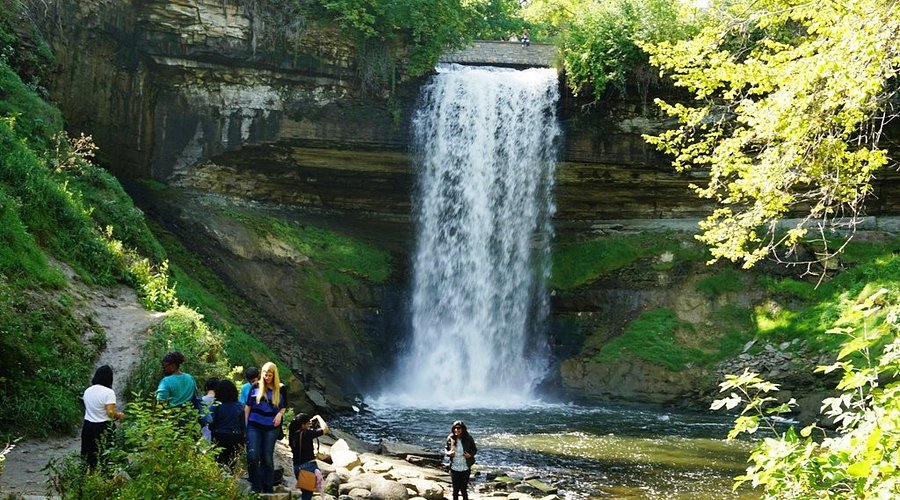
In the heart of Minneapolis, a short drive from downtown and easily accessible by light rail, a creek drops 53 feet over a limestone ledge into a wooded gorge, creating one of the most beloved natural landmarks in the Twin Cities. Minnehaha Falls has been a gathering place for generations of Minnesotans and visitors alike, celebrated in poetry by Henry Wadsworth Longfellow, documented by photographers since the earliest days of the medium, and surrounded by one of the finest urban parks in the country. It’s the kind of place that locals visit dozens of times and still find worth returning to.
The Falls and the Gorge
Minnehaha Creek flows eastward across the southern Minneapolis suburbs before plunging over the falls and continuing through a deep, wooded gorge down to the Mississippi River. The falls themselves are at their most powerful in spring, when snowmelt swells the creek and the water roars over the ledge in a curtain of white. By late summer, the flow often diminishes to a quieter stream, but the falls remain beautiful in every season. In winter, the spray from the falls builds up on the surrounding rocks and vegetation to create dramatic ice formations, and on the coldest years the falls freeze entirely into a spectacular column of ice that attracts photographers from across the region.
Below the falls, the gorge trail follows Minnehaha Creek through a surprisingly wild stretch of natural landscape for such a dense urban environment. Limestone cliffs line the sides of the gorge, and the canopy of trees overhead creates a sense of genuine enclosure and quiet. The gorge trail eventually connects to the Mississippi River Trail at the river’s edge, making it possible to walk from the falls all the way to the Mississippi on foot, a distance of about one mile through consistently beautiful scenery.
Minnehaha Regional Park
The falls are the centerpiece of Minnehaha Regional Park, a 193-acre Minneapolis city park that extends along both banks of the creek and includes picnic areas, playgrounds, athletic facilities, and a series of well-maintained paved and natural trails. The park is one of the busiest in the Minneapolis parks system, which is consistently ranked among the finest urban park systems in the country.
The main lawn above the falls is a popular gathering spot on warm days, with families spreading out picnic blankets and groups gathering around the large stone pavilion. The park has a seasonal restaurant, Sea Salt Eatery, which has become almost as beloved as the falls themselves. Located in the old park building near the falls overlook, Sea Salt serves excellent fresh seafood, including fish tacos, shrimp po’boys, and a variety of other coastal-inspired dishes in a decidedly landlocked but entirely appropriate setting. Lines for Sea Salt can be long on sunny summer days, but the food is worth the wait.
Longfellow’s Legacy
Henry Wadsworth Longfellow never visited Minnehaha Falls himself, but his 1855 epic poem The Song of Hiawatha immortalized the waterfall and the surrounding landscape. Longfellow based his descriptions on written accounts and engravings of the falls, imagining a Native American world along the banks of the creek. The poem gave Minnehaha Falls a national fame that preceded photography and helped establish it as a must-see destination for 19th-century tourists.
A statue of Hiawatha and Minnehaha, the poem’s central characters, stands in the park near the falls and remains one of the most iconic public sculptures in Minneapolis. Longfellow’s connection to the falls is celebrated throughout the park and the surrounding Longfellow neighborhood, which takes its name from the poet.
Statues and Historic Structures
Beyond the Hiawatha and Minnehaha statue, the park contains several other interesting historic elements. The John H. Stevens House, the oldest frame house in Minneapolis, was moved to the park in 1896 in a remarkable feat that involved thousands of Minneapolis schoolchildren pulling the house on rollers through the streets. The house is now a city museum open for tours. The Park Pavilion, built in 1904, is an elegant old structure housing the Sea Salt restaurant and providing a handsome backdrop to the upper falls area.
Seasonal Activities and Nearby Connections
Minnehaha Regional Park is a year-round destination. In summer, the paved trail along the creek is a popular route for cyclists and inline skaters connecting to the broader Minneapolis trail network. The Grand Rounds Scenic Byway, a legendary system of parkways circling the city, passes through the park. In winter, the park is popular for cross-country skiing, snowshoeing, and cold-weather photography, especially when the falls freeze.
The park sits adjacent to the Fort Snelling State Park and the Minnesota Valley National Wildlife Refuge, both of which offer significant natural areas and additional trails. The nearby Fort Snelling Historic Site, a restored 19th-century military fort at the confluence of the Minnesota and Mississippi rivers, makes an excellent companion visit. Together, these sites form one of the richest historical and natural clusters in the Twin Cities.
Getting There
Minnehaha Regional Park is located at the intersection of Minnehaha Avenue and Hiawatha Avenue in south Minneapolis. It’s one of the easiest major attractions in the Twin Cities to reach by public transit: the Blue Line light rail has a Minnehaha Park station directly adjacent to the falls area, making it possible to arrive from the airport or downtown Minneapolis without a car. Parking is available in a large lot off Godfrey Parkway, though it fills on warm summer weekends. The park is open year-round, and admission is always free.
Minnehaha Falls is one of those places that reminds you what urban parks at their best can do for a city. It’s a place of genuine natural beauty, historic resonance, and community gathering, all wrapped up in an accessible and well-maintained green space in the middle of one of America’s great cities. If you’re in Minneapolis for any length of time, visiting the falls should be near the top of your list.