Across the Mississippi River from St. Louis, in the floodplain of southwestern Illinois, the remains of the largest pre-Columbian city north of Mexico spread across a landscape of earthen mounds that have endured for nearly a thousand years. Cahokia Mounds State Historic Site preserves more than 80 surviving mounds from a city that at its peak around 1100 CE had a population estimated at 10,000 to 20,000 people, making it comparable in size to London at that time. Designated a UNESCO World Heritage Site in 1982, Cahokia is one of the most significant archaeological sites in North America and one of Illinois’ most remarkable attractions, a place that fundamentally changes your understanding of American history before European contact.
The City of Cahokia
The Cahokia civilization is associated with the Mississippian culture, a complex society that developed in the river valleys of the Midwest and Southeast roughly between 800 and 1600 CE. Mississippian peoples were sophisticated farmers who grew corn, beans, and squash, and they built their largest communities around central plazas anchored by large earthen platform mounds used for ceremonial and civic purposes. Cahokia was the largest of these cities, covering about six square miles at its peak and connected to a network of smaller settlements across the region through trade and political relationships.
The city’s residents shaped the landscape on a massive scale, moving an estimated 55 million cubic feet of earth to build the mounds and create the flat plazas that organized the city’s social space. Archaeologists have found evidence of sophisticated craft production, long-distance trade in goods from throughout North America, a complex social hierarchy, and a rich ceremonial life. The reasons for Cahokia’s decline, which was well underway before European contact, remain subjects of research and debate.
Monks Mound
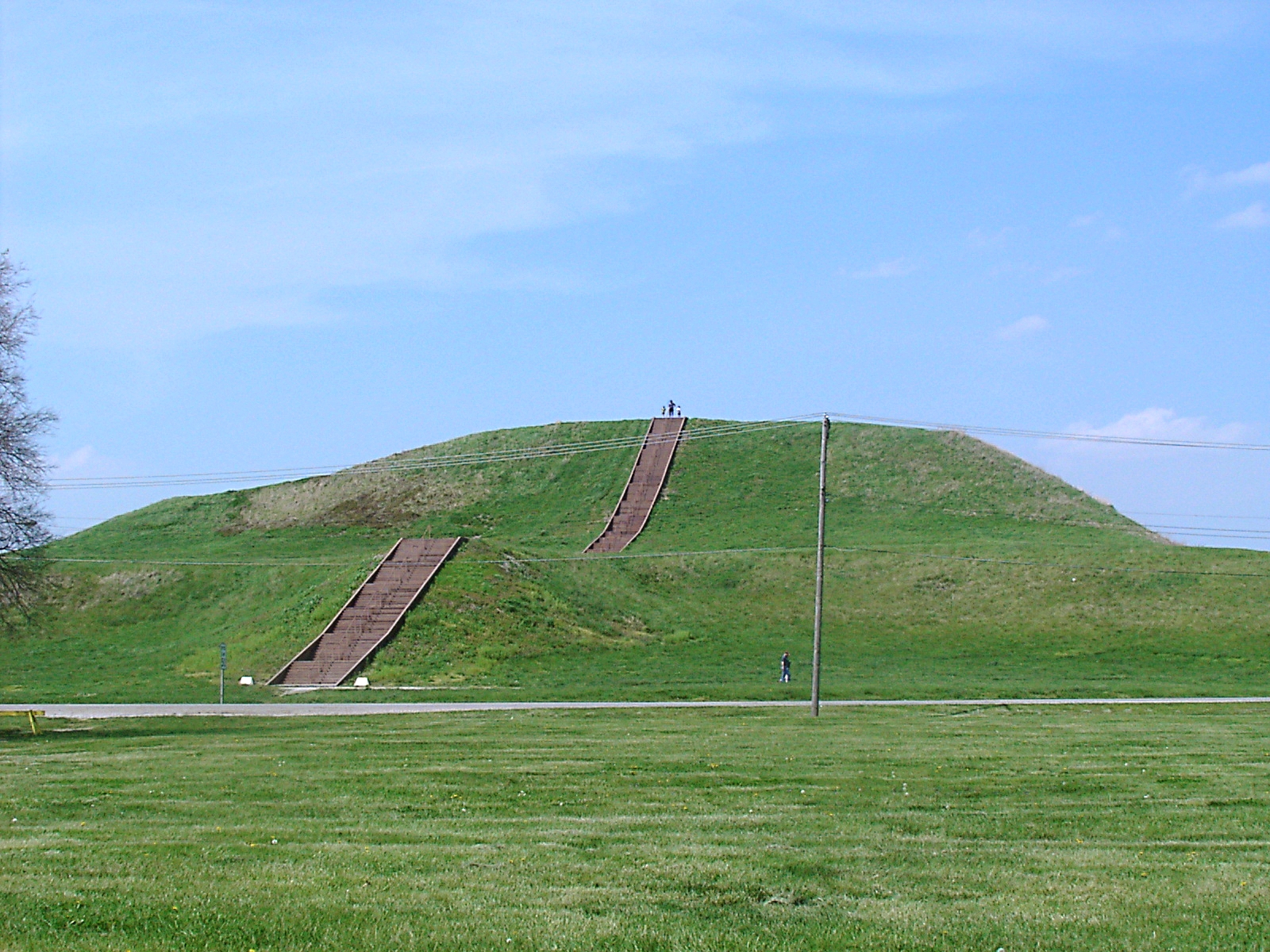
The centerpiece of the Cahokia Mounds site is Monks Mound, the largest prehistoric earthwork in the United States and one of the largest in the world by volume. The mound covers 14 acres at its base, rises about 100 feet in four terraces, and contains an estimated 22 million cubic feet of earth. It is larger at the base than the Great Pyramid of Giza, though far less tall. The flat top of the highest terrace once supported a large wooden structure that archaeologists believe served as the residence and seat of power of Cahokia’s ruling elite.
A broad set of steps leads up the south face of Monks Mound to the summit, and the climb, while not strenuous, is enough to provide real perspective on the mound’s scale. From the top, on clear days, you can see the Gateway Arch in St. Louis across the river, and the expanse of the floodplain stretching in all directions gives a sense of the geography that made this location so powerful for a river-focused civilization. The view is extraordinary and the experience of standing atop this ancient monument is genuinely moving.
Woodhenge
One of the most fascinating discoveries at Cahokia was a series of large circles of red cedar posts, reconstructed and collectively called Woodhenge, that functioned as solar calendars allowing the city’s inhabitants to mark the solstices, equinoxes, and other divisions of the agricultural year. Five separate post circles have been identified, and the largest has been reconstructed near its original position on the west side of the site. Standing at the observation post at sunrise on the spring equinox, watching the sun rise in alignment with Monks Mound on the eastern horizon, is one of the most evocative experiences the site offers.
The Woodhenge reconstruction makes the astronomical sophistication of the Cahokia civilization immediately tangible. The people who built this city were not primitive; they had a detailed understanding of the sun’s movements across the year and the ability to translate that knowledge into large-scale physical structures that organized their community’s relationship with the natural world.
The Interpretive Center
The Cahokia Mounds Interpretive Center provides context essential for appreciating what you’re seeing on the site. The exhibits use artifacts from archaeological excavations, detailed dioramas, and clear narrative explanations to bring the Cahokia civilization to life. The building’s design mimics the silhouette of a mound and is thoughtfully oriented to the site’s axis. The interpretive center is free to enter, though donations are encouraged. Films shown in the center’s theater provide additional background on the site’s history and significance.
The center’s gift shop carries an excellent selection of books on Mississippian culture, Native American history, and Cahokia specifically, along with reproductions of archaeological artifacts and locally made crafts. It’s one of the better museum gift shops in Illinois for those interested in going deeper into the site’s history.
Getting There
Cahokia Mounds State Historic Site is located at 30 Ramey Street in Collinsville, Illinois, about 8 miles east of the Gateway Arch in St. Louis and easily accessible from Interstate 55/70 via exit 6. The site is open year-round, with the interpretive center closed on major holidays. Admission to the site and grounds is free; donations support ongoing research and preservation. The site is large enough to warrant a half day’s visit minimum, and combining Monks Mound with a tour of the surrounding mound complex and the interpretive center takes about two to three hours.
Cahokia Mounds is one of those sites that recalibrates your sense of American history. The assumption that North America north of Mexico was lightly populated by simple societies before European contact is fundamentally incorrect, and Cahokia is the most powerful single piece of evidence against that assumption. A city of 20,000 people, a monumental mound visible from miles away, a solar calendar precise enough to mark the equinoxes: these are achievements of a sophisticated civilization, and they happened here, in Illinois, a thousand years ago. Go and let that sink in.