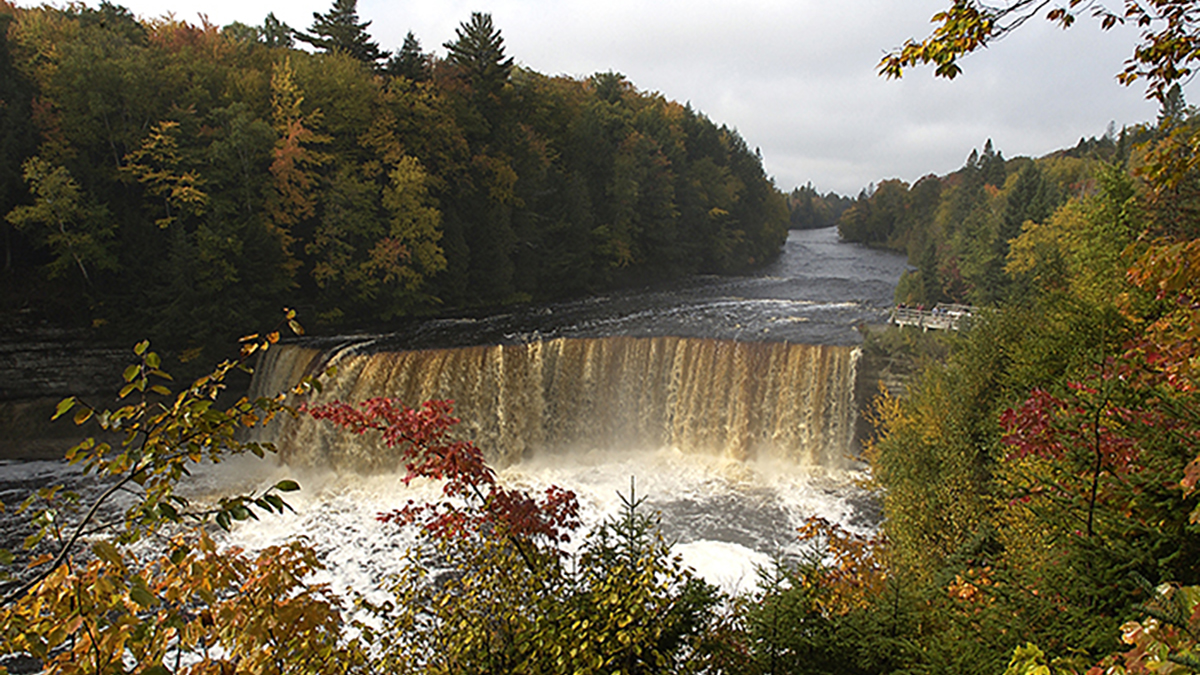
Deep in the forests of Michigan’s eastern Upper Peninsula, the Tahquamenon River gathers the amber-stained waters of a vast boreal wetland and sends them cascading over one of the most impressive waterfalls east of the Mississippi River. Tahquamenon Falls State Park protects the Upper Falls, a massive horseshoe of brown water dropping 50 feet and spanning nearly 200 feet across, as well as the Lower Falls downstream and miles of forest trails that wind through one of the most pristine wilderness landscapes in Michigan. For anyone traveling through the Upper Peninsula, a stop at Tahquamenon is not optional. It is, in the truest sense, unmissable.
The Upper Falls
The Upper Falls of the Tahquamenon are the second-largest waterfall by volume east of the Mississippi River, surpassed only by Niagara Falls. The falls discharge an average of 50,000 gallons of water per second, and during spring flood conditions the volume can exceed 100,000 gallons per second. The dramatic cascade is set against a backdrop of dense forest, and the viewing area has been thoughtfully developed with multiple observation platforms at different levels and distances that allow visitors to appreciate the falls from both panoramic and close-up perspectives.
The amber color of the Tahquamenon’s water is one of its most distinctive features. The river drains a vast area of tannin-rich wetlands and forests, and the organic compounds from decomposing vegetation stain the water a deep tea-brown that contrasts beautifully with the white foam generated by the falls. In certain light conditions, the water glows like dark amber, and the combination of color, volume, and the thundering sound of the falls creates a sensory experience of considerable power.
The walk to the Upper Falls from the East Unit parking area is a well-maintained trail of about one mile through a cathedral forest of hardwoods and conifers. The trail is beautiful in its own right, and the anticipation of the falls grows as the sound of rushing water becomes audible through the trees. A concession stand near the falls serves food and beverages, and a brewery taproom in the same building offers beers brewed with Tahquamenon River water. Sitting on the viewing deck with a locally brewed beer and the falls in front of you is a genuinely pleasant way to spend an afternoon.
The Lower Falls
About four miles downstream from the Upper Falls, the Tahquamenon splits around an island and descends through the Lower Falls, a series of five distinct drops that together create a staircase of cascades spanning the full width of the river. The Lower Falls are accessed from a separate parking area in the West Unit of the park. From the trailhead, visitors can either hike the North Country Trail along the river bank to the falls or rent a rowboat and paddle to the island between the two channels of the Lower Falls.
The rowboat experience at the Lower Falls is one of the most unique outdoor activities in Michigan. Visitors paddle their rented boats through the calm water between the channels, pull up on the island, and then walk to view both channels of the falls from the island itself, surrounded by rushing water on both sides. The experience is unhurried and thoroughly enjoyable, with the rental fee covering a set amount of time on the water. This is a particularly excellent activity for families with children who want more engagement than a standard viewpoint provides.
Hiking and the North Country Trail
Tahquamenon Falls State Park has extensive hiking trails beyond the immediate falls area. The North Country National Scenic Trail, one of the longest hiking trails in the United States at nearly 4,600 miles from New York to North Dakota, passes through the park and follows the Tahquamenon River between the Upper and Lower Falls. The 4-mile river trail connecting the two falls sections is one of the finest stretches of the North Country Trail in Michigan, passing through remote and beautiful boreal forest with frequent river views. Backpackers can camp in the backcountry along this route, and the combined Lower-to-Upper Falls round trip makes an excellent full day of hiking.
Wildlife and Birding
The forests and wetlands of the Tahquamenon region support outstanding wildlife. Black bears are common in the area, and sightings near the park’s campgrounds and trails occur regularly. Moose are present and occasionally seen, particularly in the wet areas near the river. Bald eagles and ospreys nest in the park, and the birding for boreal species is excellent throughout the year. Canada jays, boreal chickadees, spruce grouse, and various woodpeckers are among the characteristic birds of the Upper Peninsula forest habitats found in the park.
Getting There and Planning
Tahquamenon Falls State Park is located about 12 miles west of Newberry, Michigan, on State Route 123. From the Mackinac Bridge, the drive to the park takes about 1.5 hours via Newberry. The Tahquamenon area is also a popular stop on Upper Peninsula road trips that combine Pictured Rocks National Lakeshore, Tahquamenon, and the Porcupine Mountains into a multi-day circuit of the UP’s finest natural areas. Camping within the park is available in two campgrounds near the respective falls units. The park charges a Michigan Recreation Passport fee for vehicle entry.
Tahquamenon Falls is one of Michigan’s finest natural wonders, and the surrounding park is worthy of the falls at its center. The amber water, the thunder of the Upper Falls, the rowboat experience at the Lower Falls, and the trails through ancient boreal forest create a destination that should be on every Upper Peninsula itinerary. Go in any season, stay as long as you can, and let the river remind you what Michigan is made of.