At the southern tip of Illinois, where the state narrows to a point between the Ohio and Mississippi rivers, the landscape transforms dramatically. The Shawnee Hills rise above the surrounding bottomlands, and more than 280,000 acres of federally protected forest cover their ridges and valleys. Shawnee National Forest is Illinois’ only national forest, and it contains some of the most spectacular natural scenery in the entire state: sandstone bluffs, natural stone arches, cypress swamps, deep canyons, and miles of hiking trails through a landscape that feels far more like the Ozarks or the Appalachians than the Illinois most visitors imagine. It is one of the Midwest’s best-kept secrets.
Garden of the Gods
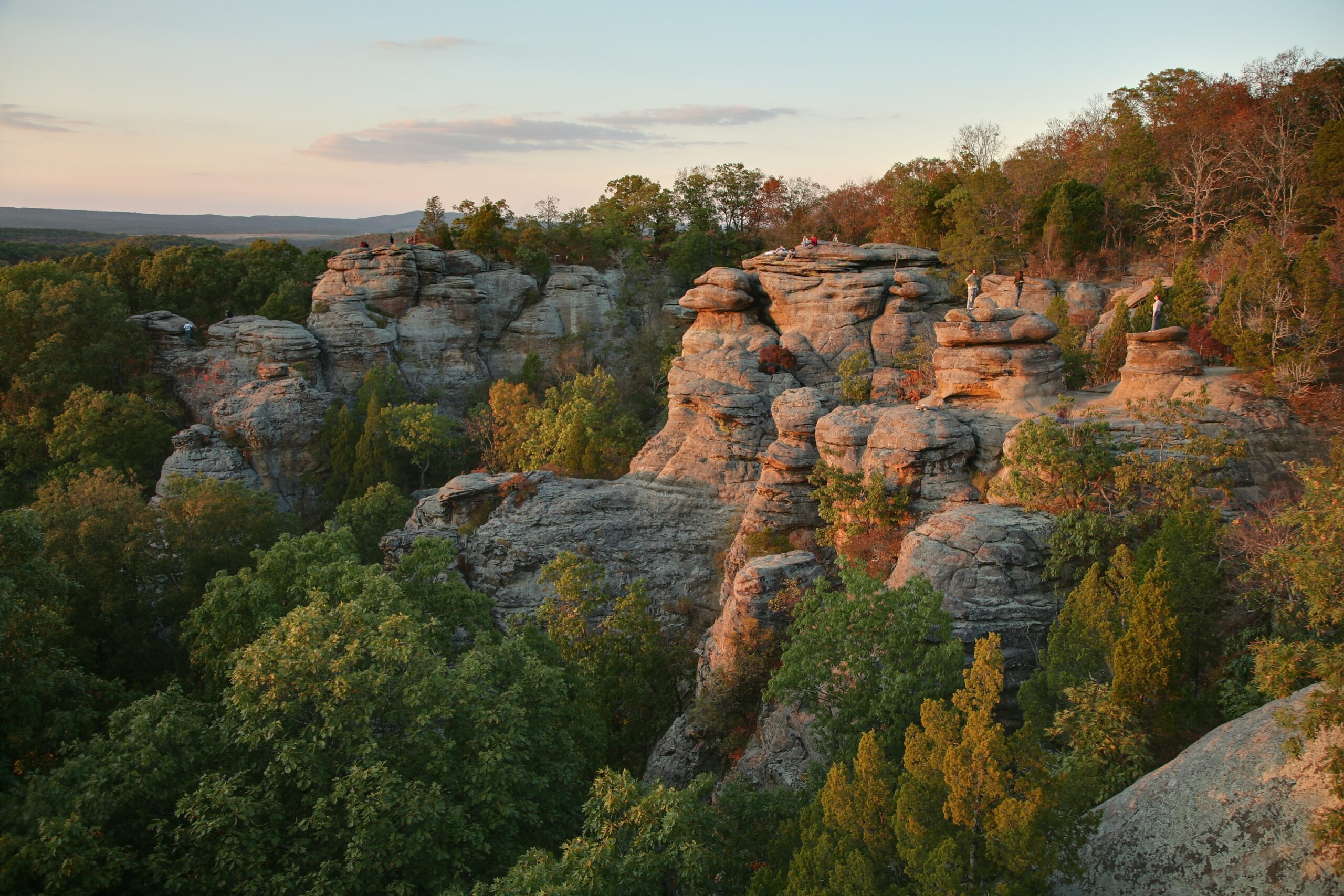
The most famous destination within Shawnee National Forest is the Garden of the Gods Wilderness Area, located near the tiny town of Elizabethtown in Hardin County. Here, ancient sandstone formations have been eroded into a dramatic collection of balanced rocks, pointed spires, broad platforms, and weathered towers that rise above the surrounding forest in a landscape that seems almost otherworldly. Formation names like Camel Rock, Anvil Rock, and Devil’s Smokestack convey the sculptural quality of the geology. The Observation Trail, a loop of about 0.3 miles, winds through the heart of the rock formations and provides easy access to the best views.
Beyond the main trail, the Garden of the Gods offers more challenging hiking along the Pharaoh Trail, a longer loop that descends into the surrounding forest and provides different perspectives on the rock formations and the broad landscape of the Ohio River valley below. The area has a designated campground and is popular for both day hiking and overnight camping. Sunsets from the Garden of the Gods overlook, with the light hitting the sandstone formations and the forested hills stretching away in every direction, are spectacular.
Natural Stone Arches
Shawnee National Forest contains several remarkable natural stone arches that are among the finest in the Midwest. Rock Hollow Trail in Pope County leads to a series of arches and overhanging rock shelters in a deeply wooded ravine. Garden of the Gods itself contains a natural arch visible from the main trail. The relatively soft Pennsylvanian-age sandstone that underlies much of the Shawnee Hills is prone to the differential erosion that creates arches and overhangs, and the forest is dotted with these formations for those willing to explore off the main tourist path.
Little Grand Canyon
Near the community of Murphysboro in Jackson County, a stretch of ravine cut by Big Creek into the sandstone bluffs above the Big Muddy River has earned the nickname Little Grand Canyon for its dramatic walls and layered geology. The Little Grand Canyon Natural Area has a 3.6-mile trail loop that descends into the canyon, follows the creek bottom, and returns via the ridge top, offering a complete cross-section of the area’s landforms. The canyon walls display the layered sandstone strata beautifully, and the canyon floor is a lush, cool environment even in midsummer heat.
LaRue-Pine Hills and the Seasonal Road Closure
One of the most ecologically significant areas within Shawnee National Forest is the LaRue-Pine Hills Ecological Area near Wolf Lake in Union County. The area combines towering limestone bluffs called the Illinois Ozarks with the Big Muddy River floodplain below, creating a dramatic juxtaposition of habitats. LaRue Road, which passes between the bluffs and the swampy bottomlands, is famous for its twice-annual closure to protect migrating snakes. In spring and fall, copperheads, cottonmouths, timber rattlesnakes, and more than 30 other snake species migrate in large numbers between the bluff hibernacula and the lowland feeding areas, and the road is closed for about a month each season to prevent mass mortality. The snake migration, visible to observers from outside the closure zone, is one of the most remarkable wildlife spectacles in Illinois.
Bald Cypress Swamps
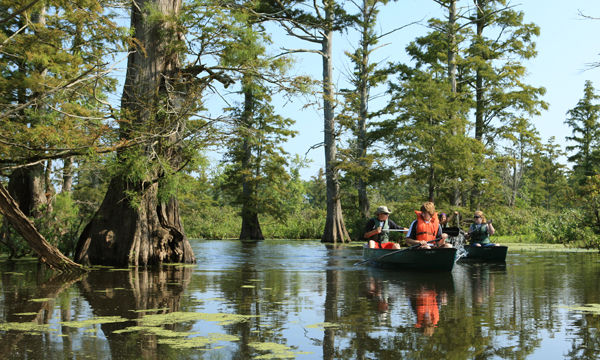
At the southern extremity of the forest, where the Cache River drains into the Ohio River bottomlands, bald cypress trees draped in Spanish moss create a swamp landscape that looks nothing like Illinois and everything like the deep South. The Cache River State Natural Area and the Heron Pond area near Karnak protect some of the finest examples of this habitat, including ancient cypress trees more than 1,000 years old. Paddling through the cypress swamp in a kayak, passing between the massive fluted trunks rising from the dark water, is an unforgettable experience that ranks among the most surprising things the Midwest has to offer.
Getting There and Planning Your Visit
Shawnee National Forest spans a wide area of southern Illinois between Carbondale and the Ohio River. The forest has two ranger districts with separate offices: the Hidden Springs Ranger District in Harrisburg and the Mississippi Bluffs Ranger District in Jonesboro. Each covers different sections of the forest. The drive from Chicago to Garden of the Gods is about five hours; from St. Louis, it’s about two hours to the western portions of the forest. The area has limited lodging options, primarily in small towns and state park campgrounds, so planning accommodations in advance is advisable.
Shawnee National Forest is the Illinois that most people don’t know exists, and discovering it tends to produce a particular kind of regional pride in those who live nearby. The rocks, the swamps, the migrating snakes, and the deep forest trails are all genuinely remarkable, and the fact that this wild and beautiful landscape exists in a state better known for corn and soybeans makes it all the more satisfying to discover. Southern Illinois is worth the drive.