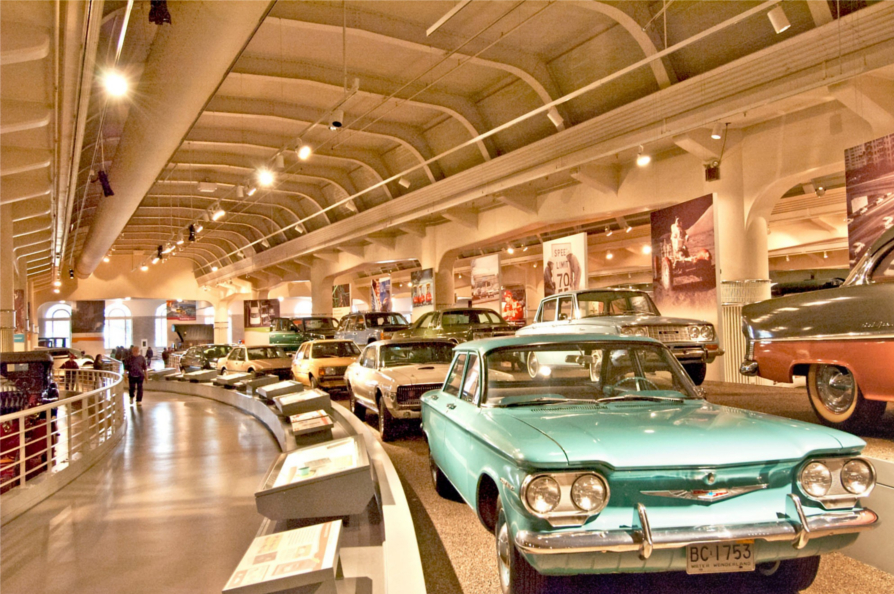
In Dearborn, Michigan, on the grounds of the enormous complex that Henry Ford created as a tribute to American ingenuity and history, one of the most remarkable museums in the country spreads across 12 acres under a single roof. The Henry Ford Museum of American Innovation, part of The Henry Ford educational institution, contains an extraordinary collection of artifacts that traces the story of American technological progress, cultural change, and everyday life across more than 300 years. It is, quite simply, one of the finest history and innovation museums in the world, and a full day spent there still won’t do it complete justice.
The Scale of the Collection
Walking into the Henry Ford Museum for the first time is a genuine jaw-dropping experience. The building is enormous, and the collection fills it completely. In a single visit you can stand next to the actual chair Abraham Lincoln was sitting in when he was shot at Ford’s Theatre, sit in the bus where Rosa Parks refused to give up her seat, walk through the limousine President Kennedy was riding in when he was assassinated, and look at George Washington’s camp bed from the Revolutionary War. The accumulation of primary historical artifacts of this significance in a single institution is virtually unparalleled.
Ford began collecting American historical artifacts in the 1920s, driven by his conviction that the everyday objects of American life, the tools, machines, furniture, and vehicles that ordinary people used, were more revealing of the country’s character than the grand objects traditionally found in museums. This philosophy shaped a collection of staggering breadth and depth. More than 26 million artifacts are in the Henry Ford collection overall, with a carefully curated selection on display in the museum at any given time.
Transportation and Innovation
Given Henry Ford’s own role in American history, it’s no surprise that the transportation and innovation sections of the museum are among its strongest. An extraordinary collection of automobiles traces the history of the American car from the earliest horseless carriages to iconic muscle cars to modern electric vehicles. Ford’s original quadricycle, his first experimental vehicle from 1896, is on display. The Dymaxion Car designed by Buckminster Fuller, a 1940s streamlined marvel, is another highlight. The collection of historic cars is extensive enough to keep automotive enthusiasts occupied for hours.
Steam locomotives and other transportation artifacts fill another major section of the museum. A 600,000-pound steam locomotive, one of the largest ever built, dominates one end of the building and gives a visceral sense of the scale and power of the steam age. Aircraft, including the plane Charles Lindbergh flew across the Atlantic, are displayed overhead in the museum’s soaring main hall.
The American Experience Galleries
The museum’s exhibits on American domestic life, agriculture, and cultural history are equally impressive. A gallery of antique farm equipment traces the mechanization of American agriculture. A collection of historic kitchen equipment, from hearth cooking tools to early electric appliances, tells the story of how American domestic life changed over the centuries. The American’s at Home exhibit explores the evolution of the American house and household through furnished period rooms and carefully contextualized artifacts.
The With Liberty and Justice for All gallery, focusing on the American civil rights movement, is among the most emotionally powerful sections of the museum. The Rosa Parks bus, the actual vehicle from the Montgomery bus system, is the centerpiece, displayed in a carefully designed exhibit that tells the full story of the Montgomery Bus Boycott and Parks’ extraordinary act of courage. Sitting in the bus, in the row behind where Parks sat, is one of those experiences that makes history feel genuinely present.
Greenfield Village
Adjacent to the museum, Greenfield Village is a separate outdoor living history attraction that is included in combined admission packages. The village contains more than 80 historic structures that Henry Ford relocated from their original sites and reassembled here, including the Wright Brothers’ cycle shop and home from Dayton, Ohio, Thomas Edison’s Menlo Park laboratory complex, and the Illinois courthouse where Abraham Lincoln practiced law. It’s essentially a greatest hits collection of American innovation history assembled in one place, with costumed interpreters and demonstrations throughout. A horse-drawn carriage ride, a steam locomotive circuit of the village, and a Model T driving experience are among the additional activities available.
Getting There and Practical Details
The Henry Ford is located at 20900 Oakwood Boulevard in Dearborn, Michigan, about 10 miles west of downtown Detroit. It’s accessible by car with ample parking, and SMART bus service connects the museum to the Detroit region’s public transit network. The museum is open daily, closed on Thanksgiving and Christmas. Admission is charged, with separate pricing for the museum and Greenfield Village, as well as combination packages. A full day should be budgeted for a thorough visit to just the museum; combining it with Greenfield Village requires at minimum two days.
The Henry Ford Museum of American Innovation earns its reputation as a world-class institution. The depth of the collection, the quality of the interpretation, and the sheer emotional impact of being in the presence of so many genuinely significant artifacts make it one of the finest museum experiences in the country. For anyone with any interest in American history, technology, culture, or everyday life, a visit to Dearborn to spend time in this museum is something you’ll never regret.