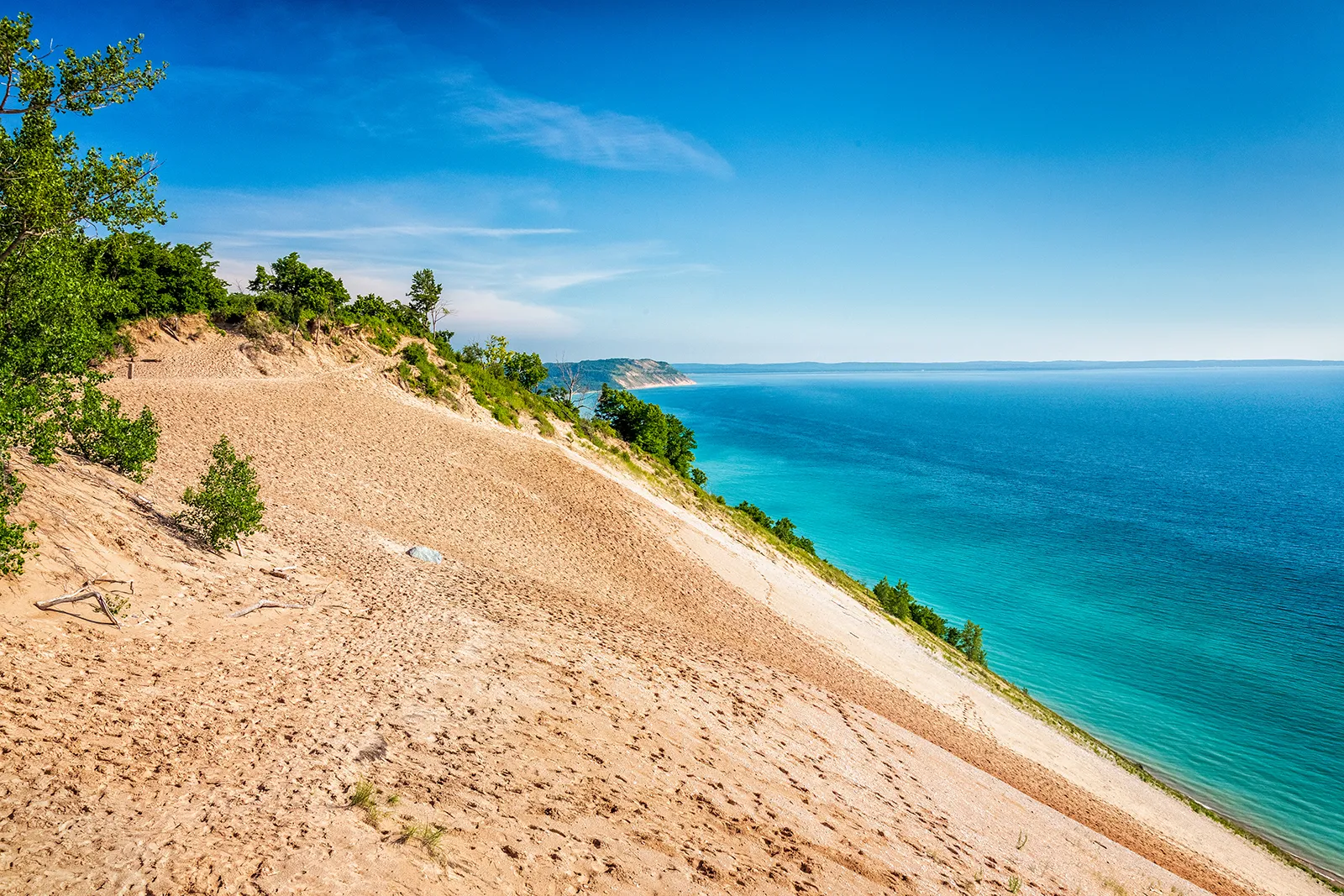
Along the northeastern shore of Lake Michigan in the northwestern Lower Peninsula, a stretch of lakeshore rises into one of the most dramatic landscapes in the Great Lakes region. Sleeping Bear Dunes National Lakeshore protects 35 miles of shoreline, two offshore islands, inland lakes, dense forest, and the towering sand dunes that give the park its name. In 2011, Good Morning America viewers voted it the Most Beautiful Place in America, and while beauty is always subjective, it’s hard to argue with the sentiment once you’ve stood at the crest of a towering dune and looked out over the impossibly blue expanse of Lake Michigan below.
The Sleeping Bear Dunes
The dunes themselves are the park’s most iconic feature and the reason most first-time visitors make the trip. These are not ordinary sand dunes. They sit perched on glacial bluffs, the remnant moraines left by retreating Ice Age glaciers, rising as high as 400 feet above the lake surface. The combination of the underlying bluff height and the accumulated sand on top creates dunes of extraordinary scale. Walking out from the Dune Climb trailhead, you ascend through sand that shifts beneath your feet, crests rise after rise, until you reach the top of the bluff and the full panorama of Lake Michigan opens before you in a sweep of blue that stretches to the horizon.
The Dune Climb is the park’s most popular trail and most accessible entry into the dune landscape. The initial climb is strenuous, with soft sand pulling at your feet on the way up, but the distance is only about 1.5 miles to the lake overlook. The descent back down is, depending on your perspective, either great fun or a knee-testing challenge. Many visitors run or slide down portions of the return slope. Children in particular love the experience. One important note: the walk from the crest of the bluff down to the actual lake shore and back is significantly longer and more demanding than many visitors realize, and people have required rescue after overestimating their ability to return. If you want to reach the water, bring plenty of water, wear good shoes, and give yourself at least three hours.
Pierce Stocking Scenic Drive
The 7.4-mile Pierce Stocking Scenic Drive is a one-way paved loop that provides access to some of the park’s finest overlooks without requiring extensive hiking. The drive passes through forest and over dune ridges, stopping at designated overlooks with interpretive signs explaining the landscape. The Lake Michigan Overlook is the most dramatic stop, where you stand at the edge of a 450-foot bluff and look straight down a near-vertical slope of sand to the crystal-blue water far below. The Sleeping Bear Point overlook, further along the drive, provides a sweeping view of the entire dune formation and the offshore Manitou Islands.
The Manitou Islands
North and South Manitou Islands, visible from the mainland shore, are accessible by ferry from Leland and are worth at least a day trip for visitors who want to add an island dimension to their Sleeping Bear experience. South Manitou Island has a campground, a historic lighthouse, and trails through a forest of ancient white cedar trees, some of the largest and oldest in the Great Lakes region. North Manitou is a true wilderness island with no facilities and no designated campsites; backcountry camping is permitted anywhere, making it a destination for experienced wilderness campers seeking real solitude.
The Sleeping Bear Heritage Trail
The Sleeping Bear Heritage Trail is a 27-mile paved multi-use trail that runs the length of the park, connecting the towns of Empire and Glen Arbor and providing access to key park features along the way. The trail is well-maintained and mostly flat, making it excellent for cycling families. Renting bikes in Glen Arbor or Empire and spending a half day on the Heritage Trail is one of the finest ways to experience the park’s diverse landscapes, from open farmfields and forest to dramatic dune views and lakeside meadows.
Glen Arbor and the Surrounding Region
The small town of Glen Arbor sits at the heart of the Sleeping Bear Dunes region and is a delightful place to base a visit. It has a handful of excellent restaurants, art galleries, and shops in a compact and walkable setting. Art’s Tavern is a beloved local institution for burgers and beers. The Cherry Republic flagship store in Glen Arbor is a celebration of the Traverse City region’s famous cherry industry, stocking an absurd variety of cherry products from wine to salsas to baked goods. Nearby Traverse City, about 25 miles north, is a full-service regional hub with abundant dining, lodging, and its own excellent wine country along the Old Mission and Leelanau peninsulas.
Practical Tips
Sleeping Bear Dunes National Lakeshore charges an entrance fee, with passes valid for seven days. The park is open year-round, though some facilities are seasonal. Summer weekends are extremely busy, especially at the Dune Climb trailhead and the Pierce Stocking Scenic Drive, which can have significant wait times to enter the one-way road. Arriving early in the morning or visiting in the evening helps beat the congestion. The shoulder seasons of May-June and September-October offer the park’s scenery with smaller crowds and pleasant temperatures. The fall colors combined with the dune landscapes in October are particularly spectacular.
Sleeping Bear Dunes National Lakeshore is one of those places that lives up to its reputation. The dunes are genuinely massive, the lake is genuinely stunning, and the whole experience of the place manages to combine natural grandeur with accessibility in a way that makes it worthwhile for visitors of nearly every age and fitness level. When people ask for the best of Michigan’s natural places, Sleeping Bear is always near the top of the list, and justifiably so.